
Build On Bedrock
Build On Bedrock
Build On Bedrock
Build On Bedrock
The bedrock principle of building — whether physical or spiritual — makes sure to rely on a firm foundation.
It’s possible to try to save $10 million and instead lose $300 million.
If the chief motive to build a building is short-term gain and not long-term flourishing for the eventual owners and tenants, shortcuts will likely be taken that cause long-term damage for everyone involved.
It’s possible to know what to do and not do it.
It’s possible to gain the world and lose your soul.
Selfishness goes for what seems best in the short term instead of what is good for others in the long term.
It’s possible to think you’re a Christian based on what you do — and find out you were never relying solely on the Rock.
A Tale of Two Foundations
The rules for building in New York City have been established for a long time.
Much of Lower Manhattan near the water is not the original island. The eastern edge of Lower Manhattan — where the Seaport sits today — was once part of the East River. This land didn’t exist until the 18th century, when New York expanded its shoreline using landfill. What looks like solid ground today is actually centuries of rubble, sand, and debris dumped into the river — with bedrock buried somewhere underneath.
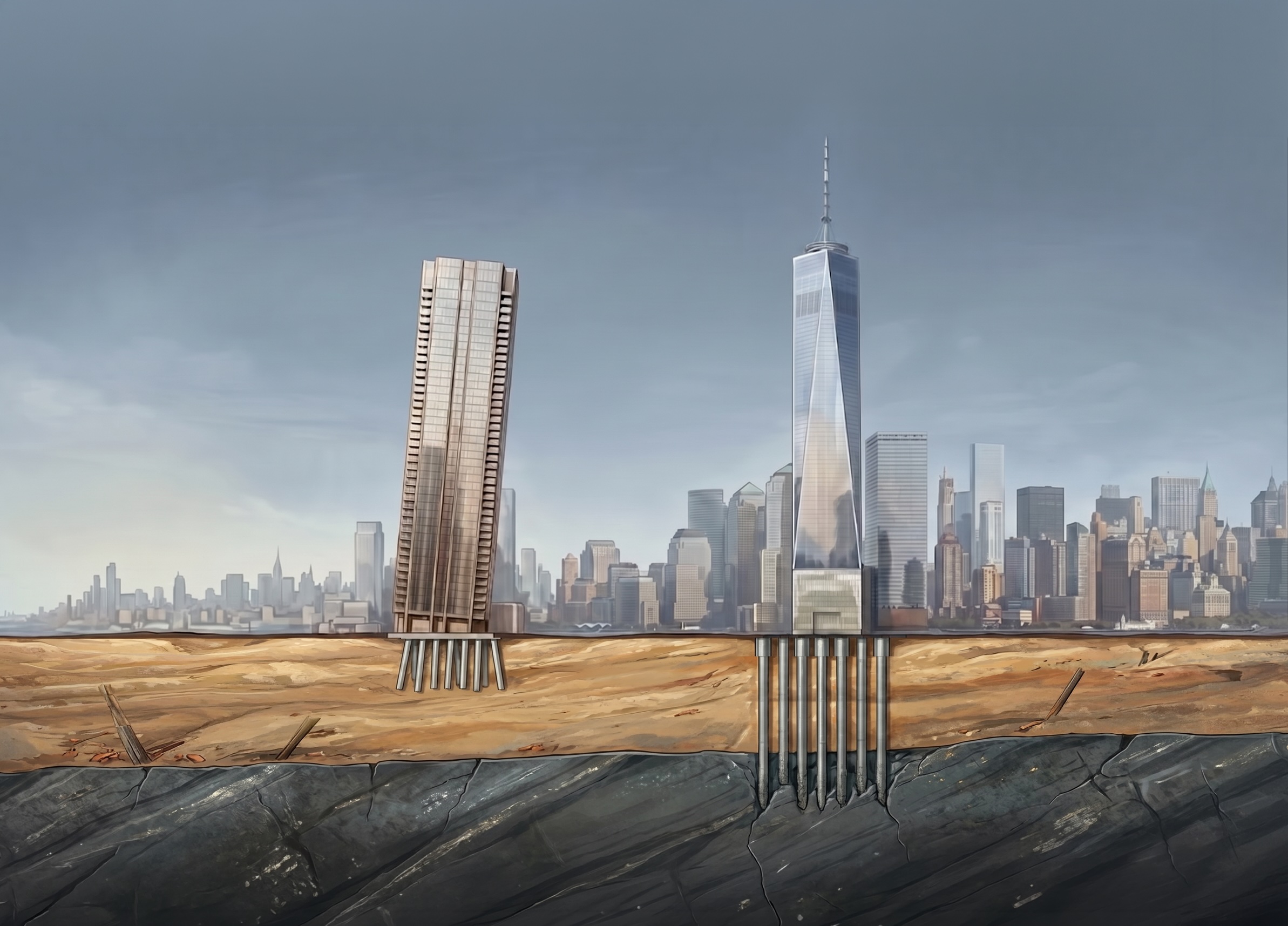
Manhattan’s iconic skyscrapers exist because engineers dig through all of that material to reach the Manhattan schist — a dense, ancient granite rock formation — and anchor everything to it. The question with every tower is always the same: did you go all the way down, or did you stop short?
“There's a reason Manhattan's towers are built into granite bedrock or have pilings that go into said bedrock. A fool's project that would have duped ignorant buyers." -Engineer commenter, NY YIMBY
One Seaport — What Went Wrong
One Seaport was planned as a 670-foot luxury residential tower — marketed as the first residential skyscraper in lower Manhattan with direct East River waterfront views, with a projected sellout of $272 million.
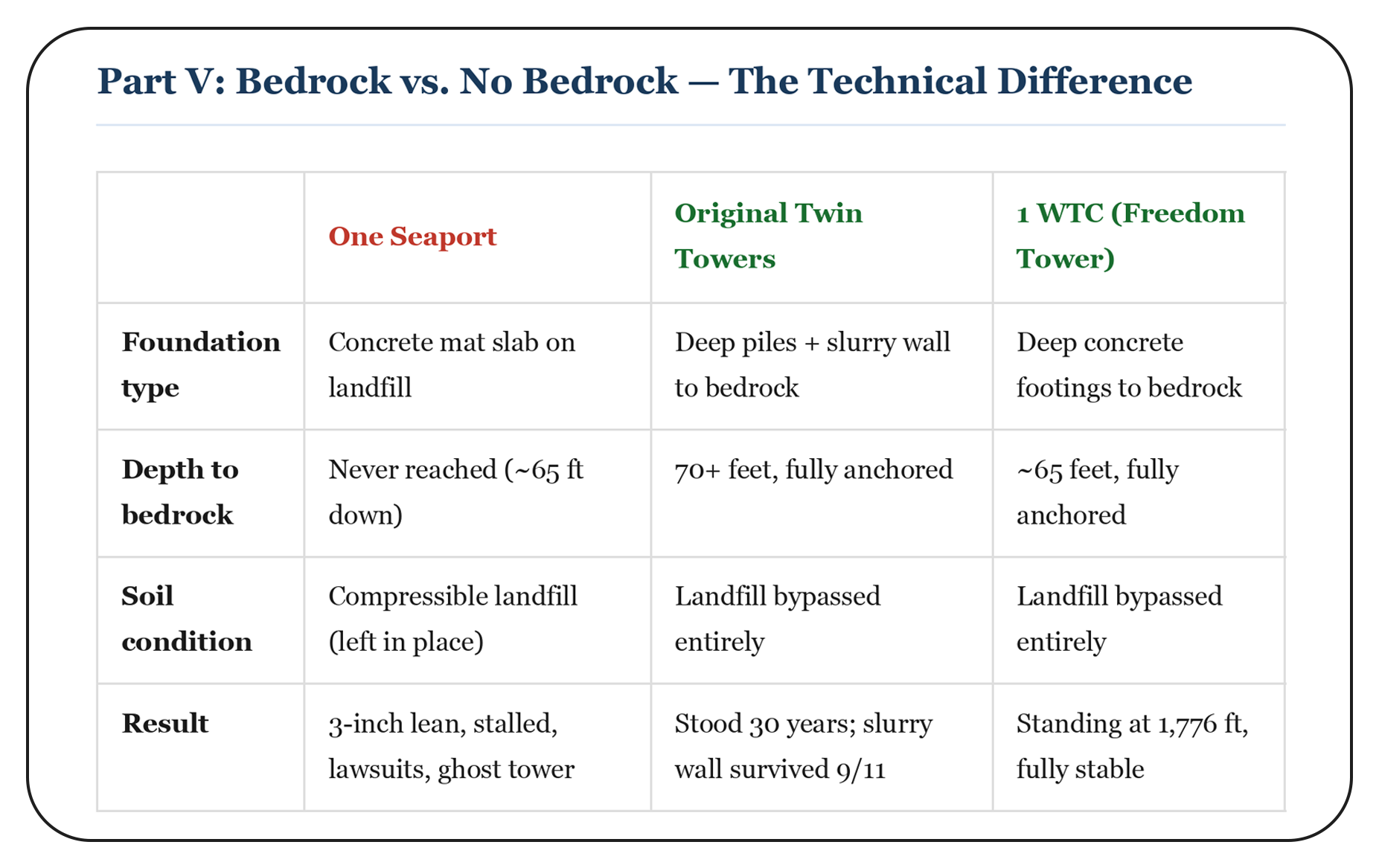
Rather than driving deep pilings down to bedrock — the standard practice for any serious Manhattan tower — the developer placed the building on a concrete mat slab sitting directly on compressible landfill. Pilings were not placed under the foundation slab, and it does not rest on bedrock. The result was predictable to any engineer who knew the ground. The soil beneath the tower compressed unevenly, causing one side of the foundation to sink slightly more than the other.
By 2019, One Seaport had developed a three-inch lean to the north — discovered when glass facade panels no longer fit properly and had to be removed for fear of falling. Construction halted. Lawsuits began. As of today, it stands largely as an exposed skeleton — unfinished, entangled in litigation, a ghost tower in the Financial District.
The World Trade Centers — What Went Right
The foundation of the Twin Towers rested directly on bedrock at a depth of more than 70 feet below street level. The slurry wall was so well engineered that it survived the catastrophic collapse of both towers on September 11, 2001. Had it failed, the Hudson River would have flooded the entire lower Manhattan subway system.
One WTC — Freedom Tower — had to achieve something even more complex: rebuild on the same site, inside the existing bathtub walls, around active PATH train tunnels, while meeting post-9/11 security and redundancy requirements that had never before been attempted in a civilian building. Engineers excavated again to Manhattan schist bedrock — approximately 65 feet down — and engineered a concrete plug at the base to seal against potential flooding. Massive concrete footings anchor the building to bedrock, extending up to 60 feet deep. The reinforced concrete core at the center of the tower measures approximately 110 feet square at the base — large enough to be its own building — with walls up to 60 inches thick and concrete strength reaching 14,000 psi, exceeding New York City standards at the time.
Build Your Life on The Rock
The bedrock principle of building — whether physical or spiritual — makes sure to rely on a firm foundation.
While the building analogy cannot comprehensively represent all aspects of faith, it’s truly worth considering.
True faith is based on what you primarily seek. Jesus told His followers the difference between them and the rest of the world, when He said:
“But seek first his kingdom and his righteousness, and all these things will be given to you as well." - [.no-reftag]Matthew 6:33[.no-reftag]
On the outside, people with true faith in Jesus and pseudo faith in Jesus can look very much the same. Just like two houses or two skyscrapers— they’re adorned nicely.
Everyone wants peace, hope, forgiveness, joy, and to be loved. Everyone wants to be valued.
The false disciples of Jesus can even look like they’re doing more of the right thing, but their motivations are not pure. The false disciple's bedrock is not the same.
The Sermon on The Mount is Jesus' most well-known sermon and His most thorough for describing what it means to trust Him, to live through Him, with Him, and for Him.
These words are not for those who don’t believe, who are not interested in joining Jesus in the very same work He came to do. Here is the bottom line Jesus offers:
“Therefore everyone who hears these words of mine and puts them into practice is like a wise man who built his house on the rock. The rain came down, the streams rose, and the winds blew and beat against that house; yet it did not fall, because it had its foundation on the rock. But everyone who hears these words of mine and does not put them into practice is like a foolish man who built his house on sand. The rain came down, the streams rose, and the winds blew and beat against that house, and it fell with a great crash.” - [.no-reftag]Matthew 7:24-27[.no-reftag]
Jesus is describing very different people who look and act the same.
Built on Sand
The person who builds on sand may very much be religious, but they are not seeking Jesus and His kingdom and his righteousness above all things.
Self is at the center of the one who builds on sand. Here are some attributes of life built on sand.
- They pick and choose — based on their preferences and biases — what parts of God’s word they will do
- They seek short-term comfort over long-term flourishing
- They hate to be temporarily uncomfortable
- They hate to admit weaknesses
- They hate to examine their own sin or have someone else point it out
- They may do good works, but they use religion — even the Bible to justify themselves
- They think they deserve certain privileges based on their actions
- They consider their needs first in storms
The storms of life reveal what someone’s faith is built on.
Built on Rock
To build on The Rock means to build on who Jesus is, and His words — to believe and do what He says.
The life of the person who builds on the rock is defined by a surrendered desire for Jesus –– to know Him, and to become like Him. Seek Jesus, His kingdom, and his righteousness above all things.
Christ is at the Center of the one who builds their life on Jesus. They understand they have been crucified with Christ and they no longer live but it’s Christ who lives in them (Galatians 2:20). Here are some attributes of life built on The Rock.
- A deep desire for Jesus, constantly wanting to grow closer to Him
- Surrender to God’s Word
- Freely admitting weaknesses — even boasts in them!
- Freely admits their sin and wants to correct their behavior
- Is completely aware they need a Savior — now and forever
- Not focused on the present, but focused on the future — our future with God
- Know they are completely unworthy to receive Jesus, have gifts, friends, and even possessions
- They are bearing fruit, they acclaim Jesus, they are walking in the Light and leading others to the Light
- They do excellent work that lasts past this lifetime that blesses others and leads to Jesus
- Knows they are completely unworthy to have gifts, friends, even possessions
- They consider what God is doing and the needs of others — even in their storms
"The man who builds upon the rock is a person who loves God for God's sake and whose supreme desire and concern is that God's name and God's glory may be magnified and spread abroad." - Martyn Lloyd Jones
The true follower of Jesus constantly wants to be with Him and work for Him in building God’s kingdom on earth as it will be in heaven.
Resources:
Article: Let Worry Go Now! | Howard Graham
Article: The Impossible Is Possible | Howard Graham
Video: The Blessing and the Calling of the Beatitudes | Howard Graham
Sermon: The Wise and the Foolish Builder | Voddie Baucham
Sermon: The Two Men and the Two Houses | Martyn Lloyd Jones
Sermon: Rock and Sand | Martyn Lloyd Jones
Video: The Advantage of Building on Bedrock | Charlie McCarty

It’s possible to try to save $10 million and instead lose $300 million.
If the chief motive to build a building is short-term gain and not long-term flourishing for the eventual owners and tenants, shortcuts will likely be taken that cause long-term damage for everyone involved.
It’s possible to know what to do and not do it.
It’s possible to gain the world and lose your soul.
Selfishness goes for what seems best in the short term instead of what is good for others in the long term.
It’s possible to think you’re a Christian based on what you do — and find out you were never relying solely on the Rock.
A Tale of Two Foundations
The rules for building in New York City have been established for a long time.
Much of Lower Manhattan near the water is not the original island. The eastern edge of Lower Manhattan — where the Seaport sits today — was once part of the East River. This land didn’t exist until the 18th century, when New York expanded its shoreline using landfill. What looks like solid ground today is actually centuries of rubble, sand, and debris dumped into the river — with bedrock buried somewhere underneath.
Manhattan’s iconic skyscrapers exist because engineers dig through all of that material to reach the Manhattan schist — a dense, ancient granite rock formation — and anchor everything to it. The question with every tower is always the same: did you go all the way down, or did you stop short?
“There's a reason Manhattan's towers are built into granite bedrock or have pilings that go into said bedrock. A fool's project that would have duped ignorant buyers." -Engineer commenter, NY YIMBY
One Seaport — What Went Wrong
One Seaport was planned as a 670-foot luxury residential tower — marketed as the first residential skyscraper in lower Manhattan with direct East River waterfront views, with a projected sellout of $272 million.
Rather than driving deep pilings down to bedrock — the standard practice for any serious Manhattan tower — the developer placed the building on a concrete mat slab sitting directly on compressible landfill. Pilings were not placed under the foundation slab, and it does not rest on bedrock. The result was predictable to any engineer who knew the ground. The soil beneath the tower compressed unevenly, causing one side of the foundation to sink slightly more than the other.
By 2019, One Seaport had developed a three-inch lean to the north — discovered when glass facade panels no longer fit properly and had to be removed for fear of falling. Construction halted. Lawsuits began. As of today, it stands largely as an exposed skeleton — unfinished, entangled in litigation, a ghost tower in the Financial District.
The World Trade Centers — What Went Right
The foundation of the Twin Towers rested directly on bedrock at a depth of more than 70 feet below street level. The slurry wall was so well engineered that it survived the catastrophic collapse of both towers on September 11, 2001. Had it failed, the Hudson River would have flooded the entire lower Manhattan subway system.
One WTC — Freedom Tower — had to achieve something even more complex: rebuild on the same site, inside the existing bathtub walls, around active PATH train tunnels, while meeting post-9/11 security and redundancy requirements that had never before been attempted in a civilian building. Engineers excavated again to Manhattan schist bedrock — approximately 65 feet down — and engineered a concrete plug at the base to seal against potential flooding. Massive concrete footings anchor the building to bedrock, extending up to 60 feet deep. The reinforced concrete core at the center of the tower measures approximately 110 feet square at the base — large enough to be its own building — with walls up to 60 inches thick and concrete strength reaching 14,000 psi, exceeding New York City standards at the time.
Build Your Life on The Rock
The bedrock principle of building — whether physical or spiritual — makes sure to rely on a firm foundation.
While the building analogy cannot comprehensively represent all aspects of faith, it’s truly worth considering.
True faith is based on what you primarily seek. Jesus told His followers the difference between them and the rest of the world, when He said:
“But seek first his kingdom and his righteousness, and all these things will be given to you as well." - [.no-reftag]Matthew 6:33[.no-reftag]
On the outside, people with true faith in Jesus and pseudo faith in Jesus can look very much the same. Just like two houses or two skyscrapers— they’re adorned nicely.
Everyone wants peace, hope, forgiveness, joy, and to be loved. Everyone wants to be valued.
The false disciples of Jesus can even look like they’re doing more of the right thing, but their motivations are not pure. The false disciple's bedrock is not the same.
The Sermon on The Mount is Jesus' most well-known sermon and His most thorough for describing what it means to trust Him, to live through Him, with Him, and for Him.
These words are not for those who don’t believe, who are not interested in joining Jesus in the very same work He came to do. Here is the bottom line Jesus offers:
“Therefore everyone who hears these words of mine and puts them into practice is like a wise man who built his house on the rock. The rain came down, the streams rose, and the winds blew and beat against that house; yet it did not fall, because it had its foundation on the rock. But everyone who hears these words of mine and does not put them into practice is like a foolish man who built his house on sand. The rain came down, the streams rose, and the winds blew and beat against that house, and it fell with a great crash.” - [.no-reftag]Matthew 7:24-27[.no-reftag]
Jesus is describing very different people who look and act the same.
Built on Sand
The person who builds on sand may very much be religious, but they are not seeking Jesus and His kingdom and his righteousness above all things.
Self is at the center of the one who builds on sand. Here are some attributes of life built on sand.
- They pick and choose — based on their preferences and biases — what parts of God’s word they will do
- They seek short-term comfort over long-term flourishing
- They hate to be temporarily uncomfortable
- They hate to admit weaknesses
- They hate to examine their own sin or have someone else point it out
- They may do good works, but they use religion — even the Bible to justify themselves
- They think they deserve certain privileges based on their actions
- They consider their needs first in storms
The storms of life reveal what someone’s faith is built on.
Built on Rock
To build on The Rock means to build on who Jesus is, and His words — to believe and do what He says.
The life of the person who builds on the rock is defined by a surrendered desire for Jesus –– to know Him, and to become like Him. Seek Jesus, His kingdom, and his righteousness above all things.
Christ is at the Center of the one who builds their life on Jesus. They understand they have been crucified with Christ and they no longer live but it’s Christ who lives in them (Galatians 2:20). Here are some attributes of life built on The Rock.
- A deep desire for Jesus, constantly wanting to grow closer to Him
- Surrender to God’s Word
- Freely admitting weaknesses — even boasts in them!
- Freely admits their sin and wants to correct their behavior
- Is completely aware they need a Savior — now and forever
- Not focused on the present, but focused on the future — our future with God
- Know they are completely unworthy to receive Jesus, have gifts, friends, and even possessions
- They are bearing fruit, they acclaim Jesus, they are walking in the Light and leading others to the Light
- They do excellent work that lasts past this lifetime that blesses others and leads to Jesus
- Knows they are completely unworthy to have gifts, friends, even possessions
- They consider what God is doing and the needs of others — even in their storms
"The man who builds upon the rock is a person who loves God for God's sake and whose supreme desire and concern is that God's name and God's glory may be magnified and spread abroad." - Martyn Lloyd Jones
The true follower of Jesus constantly wants to be with Him and work for Him in building God’s kingdom on earth as it will be in heaven.
Resources:
Article: Let Worry Go Now! | Howard Graham
Article: The Impossible Is Possible | Howard Graham
Video: The Blessing and the Calling of the Beatitudes | Howard Graham
Sermon: The Wise and the Foolish Builder | Voddie Baucham
Sermon: The Two Men and the Two Houses | Martyn Lloyd Jones
Sermon: Rock and Sand | Martyn Lloyd Jones
Video: The Advantage of Building on Bedrock | Charlie McCarty