
Stay Connected to The Source for Much Fruit and Joy in Love
.png)
Stay Connected to The Source for Much Fruit and Joy in Love
Stay Connected to The Source for Much Fruit and Joy in Love
Stay Connected to The Source for Much Fruit and Joy in Love
First, abide in Jesus to become like Jesus. This is what you're meant to be. Then, abide in Jesus to know and have the abundant joy of Jesus. This is what you’re meant to know. Lastly, abide in Jesus to do the work to love Jesus. This is what you’re meant to do.
Are We Connected?
Who is looking for deeper connection? Who wonders all the benefits that can be had with deeper connections? And those are the things we're going to talk about. But hang on. In my nervousness, I forgot to turn off my alerts on my phone. And Oops. Oh no. I have some alerts. I got four likes on my last post. And somebody said in the comments, "Ah, that's the best." And then there's some World Cup updates. It's pretty cool. And there's a baseball tournament in Hoover. Yeah. Yeah. Uh oh. And rats! Lane Kiffin said more bad stuff about well, you know who. And yikes, a work thing. I think I can wait till after the service or maybe after Sunday. And then one of those cat videos from Aunt Susie. Awesome. I can't wait. (Ha ha)
Friends, is this us? Is this our distraction?
The average American spends 5 hours and 16 minutes a day on their phone. Is this connection? They check their phone 205 times per day. They spend two hours and 20 minutes a day on social media. They check their phone 10 minutes after waking up. Our most frequent connection is wrecking us. And we were made to be connected. Connected deeply.
Here are some of the impacts of that. It's causing mental health deterioration, depression, anxiety, and even suicidal ideation — especially when you add in AI. It's causing sleep destruction and cognitive drain, attention and concentration issues, and relationship erosion. The research doesn't just show that the phones are distracting. It shows they're systematically replacing that which makes human life rich.
You know who said the last thing? That's a quote from Claude. If you don't know Claude, I'll tell you about him later. 71% of Americans admit to spending more time on their phones than with their romantic partners. And it's not much better for Christians. Christians are spending 10 to 20 times more on social media than they are in scripture. Friends, it's not supposed to be that way.
We are made for deep, deep connection. And I'm excited. I'm not worthy, but I'm excited to bring God's word to you today. And these verses — probably no verses have spoken to me more over the last five years. So I'm excited for you to hear the life that is in those.
It’s Always Been About Fruit
The vineyard is a portrait. This is how we're meant to be. The vineyard is a portrait of what you're meant to be. The vineyard is a portrait of what you and your family are meant to be and how you're meant to connect — to bear much fruit. The vineyard is a portrait of Downtown Church and where we want to go — that in God's church, which nothing can stand against across the Bible. Vine, vineyard, fruit, branch, harvest, grapes, wine press — mentioned about a thousand times. The most common of which is fruit. God wants to bear fruit through you.
It all starts in Genesis where abundance is first mentioned. Even before the fall of man, the vine and vineyards are flowing. There's great abundance and fruit. Then the first thing Noah does after the flood is plant a vine. God sees us as his branches. And we were meant to bear fruit. We're meant to be connected to God and fruit-bearing people. And bearing fruit leads to more abiding in God.
But sometimes we don't. And guess what? Israel didn't either. This isn't a New Testament thing. Everything that was meant to be clear is in the Old Testament. But listen, vine references are all over the Psalms and all over the book of Isaiah.
This passage from Isaiah is called a Song of the Vineyard. And you'll be able to see some New Testament in it.
"Let me sing my beloved, my love song concerning his vineyard. My beloved, I have a vineyard on a fertile hill. He dug it. He cleared it of stones and he planted it with choice vines. He built a watchtower in the midst of it and he hewed out a wine vat in it. And he looked for it to yield grapes, but it yielded wild grapes. Oh now, oh inhabitants of Jerusalem, the men of Judah, judge between me and my vineyard. What more was there to do for my vineyard that I have not done for it? When I look for it to yield grapes, why did it yield wild grapes? And now I will tell you what I will do to my vineyard. I will remove the hedge and it shall be devoured. I will break down its wall and it shall be trampled upon. I will make it waste. It shall not be pruned or hoed. And the briars and the thorns shall grow up. I will also command the clouds — no rain upon it. For the vineyard of the Lord of hosts — that is the house of Israel and the men of Judah — are his pleasant planning. And he, God in this case, looked for justice, but behold bloodshed, for righteousness, but behold an outcry." - [.no-reftag]Isaiah 5:1-7[.no-reftag]
And that's just the first seven verses. He goes on from there, the next 10 verses to decry woes. The woes include being too connected to the world and building and connecting farms and connecting houses — and he told you to stay pure and stay on him. And we didn't. Woes regarding being intoxicated, inflamed by strong drink. You know, you'd think of a metaphor about a vine and vineyard would make a little room for drinking wine, but it's saying be very careful with that. And then there are woes — the biggest woe of all — about you deciding what's right about us looking at God's word and saying, "Here's what's right and here's not." He says, "Woe to those who call evil good and good evil, who put darkness for light and light for darkness, who put bitter for sweet and sweet for bitter."
All right, back to our vine.
That's what happens when we're not connected to the vine. God wants to bear fruit. So, do we need a savior? Yes. Are you ready for the good news? So, are you ready for the good news? So, here's our main idea.
Abide. Remain connected to Jesus for assurance and for the joyful, abundant, fruitful life you were made to live.
Note: "Abide" is used 9 times in the ESV in [.no-reftag]John 15:1–11[.no-reftag]; "remain" 10 times. Abide is rich connection, deepness, fellowship with Jesus. Remain means stay connected, stay in Jesus. Don't leave. Some more synonyms if you want them — abide, endure, last, persist, hold on, linger, wait, remain. Do not leave. Stay with him. Abide richly and stay with him. That's the invitation all the time.
This is Personal
Today I know there are those of you who are struggling and need assurance that God is with you. We have people who want to know what life is really about. People that wonder, does a Christian life really matter? We have people not finding joy in Jesus. And I believe this text answers all those things.
So, I invite you right now to take a minute and write down where you're struggling the most just for you. Even if it's an upside opportunity, where has your mind been these last few days? Write it down and see if God's word does not give you an answer today.
So, first we have context. This is the final of the "I Am" statements we've learned. He's the bread of life. I'm the light of the world. I'm the gate. I am the good shepherd. Jesus says, I am the resurrection, the life. I'm the way, the truth, and the life. And that was said in the right now we're in a setting where Jesus is in the upper room talking to his disciples for the last time before he goes out to be arrested, betrayed — arrested, betrayed some more, beaten, scourged, and hung on a cross. So he wants to make sure they get it.
And you'd think "I'm the way, the truth, and life" would be enough, but he wants to tell them one more thing. So he said, "Let's rise and go from here." But first he reminds them everything the father sent him to do he's done. He says let's rise and go. And they make their way from the upper room and they go across most likely the Kidron Valley here and into the Garden of Gethsemane. They would have been really aware that the Passover — so blood would have been flowing down that valley — and he would have been very aware of what his task was in the next few hours. And he's telling them the main thing they need to know when they struggle. Jesus is giving them answers for struggles in all of life.
Okay, so here's our three-point outline. We're supposed to give a three-point outline, right? There's some better preachers in here than me.
Abide in Jesus to Become Like Jesus
First, abide in Jesus to become like Jesus — in the first four verses, what you're meant to be. Then secondly, abide in Jesus to know and have the abundant joy of Jesus — this is what you need to know. And abide in Jesus to do the work to love Jesus — this is what you need to do.
So first, abide in Jesus to become like Jesus. You might say, Howard, that's a little bold — to become like Jesus. Who wants to become like Jesus? Who's sure they're going to be? I want you to be sure. 1 John 3:1–3 gives us a little glimpse. And when we see him, when we behold him, we're going to become like him. And all who have this hope purify themselves because that's what he's offering us. That's what he's offering every one of us.
I remember Michael Davis teaching this at our Way to Work groups at The Center. And he came in — I thought he was teaching on knowing God better. And he immediately started talking about your biggest need. Each of your biggest needs is to become like Jesus. And I was like, "Oh, that's a little too much, Michael." But it's not. It's exactly right. If we know him, we become like him. So that's the goal. So let's break it down into these deep — into these verses — and go a little deeper.
I'm going to read it again because the power is in God's word, not mine. "I am the true vine and my father is the vine dresser. Every branch in me that does not bear fruit, he takes away and every branch that does bear fruit, he prunes that it may bear more fruit." Catch that. That's important. He prunes that it may bear more fruit. "Already you are clean because the word I have spoken to you. Abide in me and I in you. As the branch cannot bear fruit by itself unless it abides in the vine, neither can you unless you abide in me."
All right, notice here Jesus is the true vine. This means Jesus is the source of life. There is no other source of life and he abides in you. He's in you. He's with you. He's for you. Therefore, remain — abide in him. Now the father, the father is the vine dresser. He is the chief gardener. Everything on this planet, everything in this universe is his. And you know what he wants? Maximum fruit production. It's what he wants in your life. Fruit impacting others for fruit.
Presbyterians tend to call this "to glorify God and enjoy him forever." But in doing that — that beautiful statement — it's true. If you've memorized the catechism, it's the first question. But we don't want to miss what it means to glorify God because it's very specific. Glorifying God is maximum fruit production.
The father is cutting away unfruitful branches — that's in verse six. But those that are not God's children, he's cutting away. They will be cut and they'll burn forever. But you — have you been pruned lately? You don't have to raise your hands. This isn't a prune confession. But we've been pruned, haven't we? Some by our own devices, some by — by nothing that we caused at all.
But he says to this: "You that have been pruned, you are clean." These are the same words in the Greek — where Jesus and Peter are kind of wrestling over who's going to wash whose feet. He said, "Already you're clean, Peter, but just — you need your feet to be washed." This is the cleaning. But we need to continue to have our feet washed because we're still sinning and we need to remain. We are clean. We need to abide in him. He is pruning the branches that are his.
This pruning allows the very life source to come. Now, I see a couple of gardeners in here. One I know better than others. But when you prune back a bush, it can look pretty nasty, can't it? Certainly, if I did — actually, I had pruned a few that my wife wasn't very happy about me pruning, but they came back, too. I'm not sure they were pruned well, but they still came back. But the master gardener knows exactly how to prune. And if you see that in a wine valley or another place, you'll see how ugly it looks for a minute. But it comes — and it allows the juice, the very blood of Jesus. It allows it to flow. It allows it to fill up the new growth. It allows you to bear more fruit. This is how a taker becomes a giver. This is how an anxious person becomes free and joyful. Our father disciplines those he loves — through their own actions and through nothing they've done at all. The point is to prepare us to bear more fruit. He wants more fruit out of every single one of us.
Here's the bottom line. Everyone who goes under the knife — yet who believes he's pruned — is cut back and consequences arise. Unexpected things happen. We're cut back. Those who abide are not disconnected and hey don't become bitter and dry away. You'll see life. And you see the some circumstances — when hardship comes, people run and become bitter. Others — when hardship comes — they look for a chance to grow, because they're remaining, or Jesus is just doing that in them — unconsciously, confidently.
So here's the best example lately — many of you have seen this, I've talked about this with many of you — but who's seen some of the Ben Sass interviews? Anybody? I commend them to you. The 60 Minutes — I commend it to you. But he has a podcast — I commend it to you. He was a senator and he was the head of the University of Florida after that. And he just didn't think the Senate was getting things done. And now he's living on borrowed time. But as God would have it, he's a man of strong faith and he got to spend some time with Tim Keller as Tim Keller was dying of pancreatic cancer — the very disease that took Tim Keller from this planet. But he knew — he was sharing with him. Tim had so much hope.
I'll just — I mean I'm not sure — one of the most clarifying moments of my life — as Tim was dying and gave a podcast and said it took until Kathy and I had this cancer that we knew what performance-based Christians we were — until this suffering comes. And he's admitted — I was just on one of my last runs ever — I was just weeping and crying. If that man who's teaching me it's not about performance is saying he has performance too — we're doing some good work here, Lord. Why would you take this back? Well, maybe he's going to teach people to die. And one person he taught to die was Ben Sass.
Ben Sass in these interviews — he's sleeping about 15 hours a day. He's taking trial treatments. And then he's spending time being interviewed all over the country. You can find it. He has more hope and joy and purpose than anyone I've talked to lately. He's clear on things of government. He's clear on things about AI. He's clear on technology. He's clear on what we should be doing. He said, "We're not doing any of what we should be doing. This technology is going to change the world and we need to get ready. We need to stay connected" — is part of what he's saying. And he said — he'd say — if we were connected, we'd be doing different actions in our families and in our businesses and in our government.
Here's what he said. He said it in front of millions and millions of people: "There are no maverick molecules in the universe." Now he's quoting RC Sproul there, but he's saying it there. The guy interviewing him on 60 Minutes appears to not be a believer. And so — "How can you have such hope in the face of death?" And actually, he has more clarity in the face of death than almost anybody I've ever known listening to him. He's able to answer questions like this. He has so much hope. He has so much joy. He doesn't want to die. He's not asking to die. He thinks his girls are in good shape, but he thinks maybe his 14-year-old — you know — he certainly would like to get a few more milestones with him. But he's positive. He's just his own version of saying Romans 8:28. He's positive. God is in control of everything. And therefore, since he's his light and he's connected to him as a vine and he knows he's being pruned, he wants everybody to know about Jesus before he dies. And he gives us some spare advice on government — thank goodness. Praise the Lord. Even our death can bring clarity and joy when we remain in the vine.
Of course, Jesus is saying it even better. God is a great gardener and he's doing everything for maximum fruit production. As a master gardener, Jesus and God are committed to your greatness. That's what they're doing. They want you to be great. They want you to have maximum fruit production. I got that from a Tim Keller sermon — they're committed to your greatness. His mercies are new every morning. He's meeting you in the task. He's meeting you in the challenges. He's meeting you in everything, in the pruning.
And so from here on — we've talked about those in the vine and those not in the vine. The rest of this sermon is meant for you who believe. And yet it's — I hope it's invitational to those who are investigating Jesus at the same time, so that you can know what maximum fruit production is.
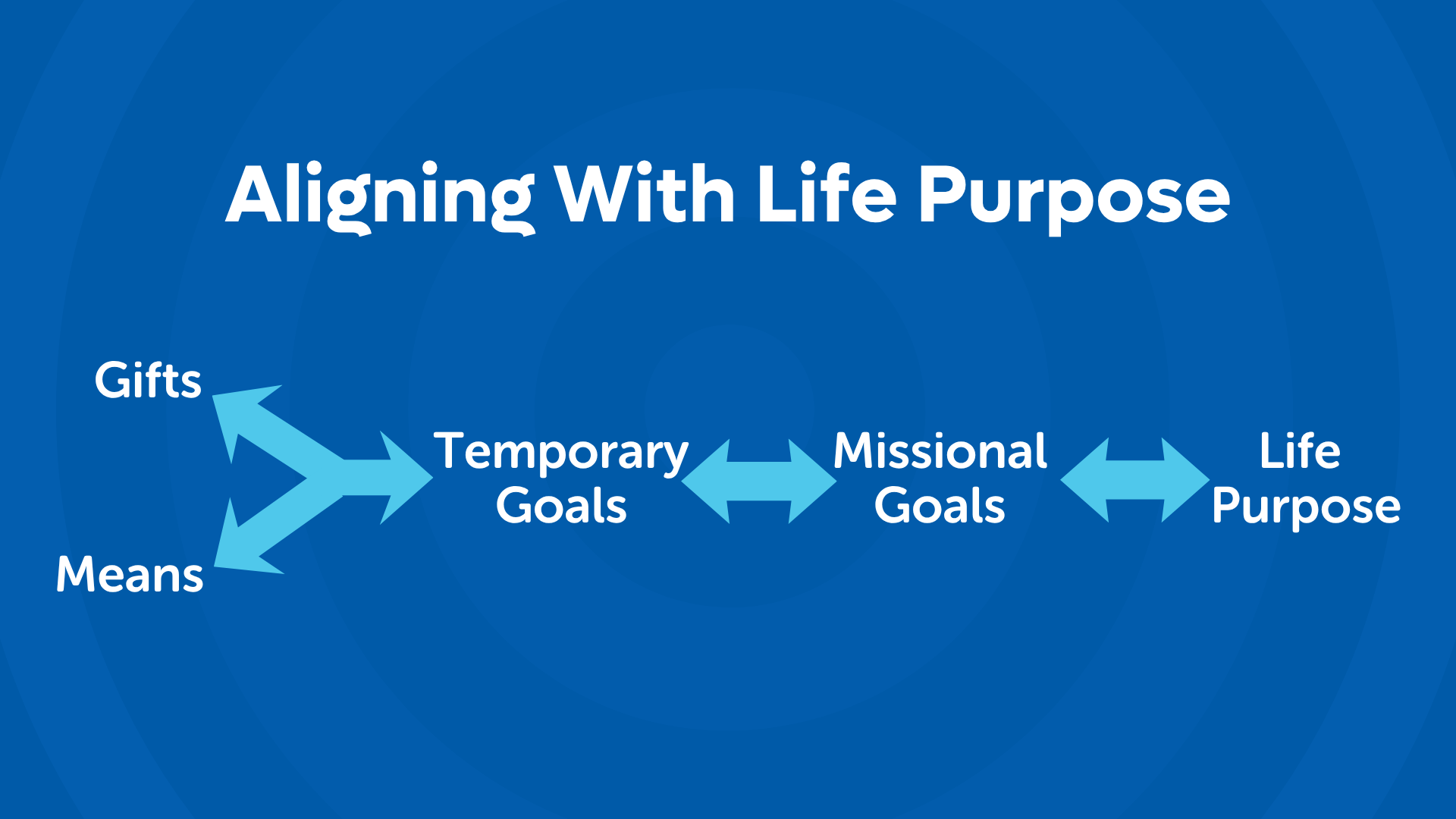
All right, here's a graphic and here's a look at what the vine looks like. When I know that the source of my life is Jesus — that I have nothing that's not from him, that I'm not able to do anything that's not through him, and there's no reason to do anything that's not for him — when I know my gifts and my means are lined up, I have peace. When I know — and what we already quoted, 1 John 3 — when I know what I'm — when I get home, I'm going to be with him. That's what life purpose is. Hope is not a strategy. Hope is a person and his name is Jesus.
Abide in Jesus to Know and Have the Abundant Joy of Jesus
Let's move to the second point. Abide in Jesus to have the abundant joy of Jesus. Jesus wants us to know some things about this. Life in him is not all about pruning, but they do require discipline.
Listen to what he says, "I am the vine and you are the branches. Whoever abides in me and I in him, he it is that bears much fruit. For apart from me, you can do nothing. If anyone does not abide in me, he is thrown away like a branch and withers. And the branches are gathered, thrown into the fire, and burned." This is clarity like nowhere else in the world. No one speaks with this authority like Jesus.
No one should be connected to anything deeper than Jesus. He says I am the vine. He says we are the branches. He says without him we can do nothing. With him we can do anything. With him we bear much fruit. But you might be saying, "Wait, I do a lot of stuff. I'm busy all day long." And what’s he saying? Our actions that are not connected to Jesus are worthless. It's not just that he provides the air in our lungs. And I wouldn't even be standing here if he didn't make a way for me to stand here. It's that you're connected to him — that you know and have assurance that what you're doing is right. That's the stuff that's worth doing. That's the work. That is the fruit — when you know you're connected and you know he's filling you.
And I'll say it again — it's the bottom line of this sermon — but I think it's just true that there are many ways to connect and memorizing verses is a very good one, Hillary. And yet maybe as I've prepared for this sermon, what I realize more than anything is when we're doing something there's no way we can do on our own power — that's when we're most connected — when we need him. We need him when we're sick. We pray to him when we're sick and pray for our relatives. We do it. But when we're doing fruit-bearing work we can't do without him in any way — so we need to stay connected. Some of you can do this unconsciously, by the way. You can be so connected and pray without ceasing. But a lot of times it takes conscious connection. He abides in us.
"If you abide in me and my words abide in you, ask whatever you wish and it will be done for you. By this my father is glorified that you bear much fruit and prove to be my disciples." Now who's praying for some stuff that hasn't happened? It happens to him, too. What's he saying here? Abide in me. Ask whatever you wish and it will be done for you. He's saying there's a deep connection.
Who's prayed something so deep and so meaningful when you know you've been connected to Jesus and you know it's from him and you know he's listened to you and you know it's going to happen — and you can praise him for it even before it happens? That's what he wants for you. It's what he's saying here. He's defining what it means to abide so tightly that when you pray, you pray the will of God in your prayers because you're so connected to him. Yes, it takes a lot of God's word to do that. But so much of our prayer is seeking mechanical correction — can I get this right? Can I fix that? Can we get this plugged in? Can this stop? All these things that we pray for. But he's saying — Tim Keller is saying — quit seeking mechanical correction. Quit seeking to do things right. God is offering organic internal transformation. He's offering us complete transformation. That's how you bear more fruit. So when you pray "his kingdom come, his will be done," you also ask Jesus what's maximum fruit production today — because that's his kingdom coming. His will be done now on earth as it is in heaven.
"As the father loved me, so I have loved you. Abide in my love. If you keep my commandments, you'll abide in my love, just as I have kept my father's commandments and abide in his love." Friends, hear this. You are loved exactly as the father loves the son. That's how well loved you are. None of us have the capacity for that for each other. But Jesus loves you exactly the way the father loves him.
And he's saying this is all really connected, by the way, because Jesus has said all along — all throughout this Gospel of John — "I can do nothing without the father." That's what not sinning is. We stay so focused on the stuff we don't want to sin — we've missed the mission. Jesus is saying, "I did nothing that wasn't the will of the father. I can't do anything without him." And he's telling us we can't do anything without him. And yet he's providing it. It's an invitation. He's saying, "Come on and do this." You're loved the way the father loves Jesus. This is the way. Is this encouraging? You're loved that way. Can you believe it? You're loved perfectly. Not everybody in your life is treating you perfectly, but you are loved perfectly. That's the promise. That's what your savior is saying.
If the love of Christ is flowing through you — healing you and preparing you. He's saying, "Now abide." If you keep his commandments — wait a minute, now we're going backwards. I thought he just loved me perfectly. I thought — this I'm telling you, John's gospel is sort of like the book of Ephesians. Each verse sort of answers the next verse. So, wait a minute. I'm loved more than I can think or imagine, but if I keep his commandments — but I know this whole deal is not performance because he did it all. He accomplished it. It's done. It's finished. He's paid for every sin. What is it that I must do? And this is what he's saying: when you follow his commands, you know you're loved. When you walk with him, when you know you're with him, when you're getting up and in his word — you get reassured that you're loved. And when you're doing what he says do, you know you're loved. It's reinforcing all the time. That's what life in the vine is — reinforcement, constantly flowing and building more and more fruit off of you when you follow his commands.
"These things I've spoken to you that my joy may be in you and that your joy may be full." That's what he wants for you. Complete and full and abundant joy — by knowing you're loved, by staying in his commands. More joy, more love all the time. This is God's purpose for your life.
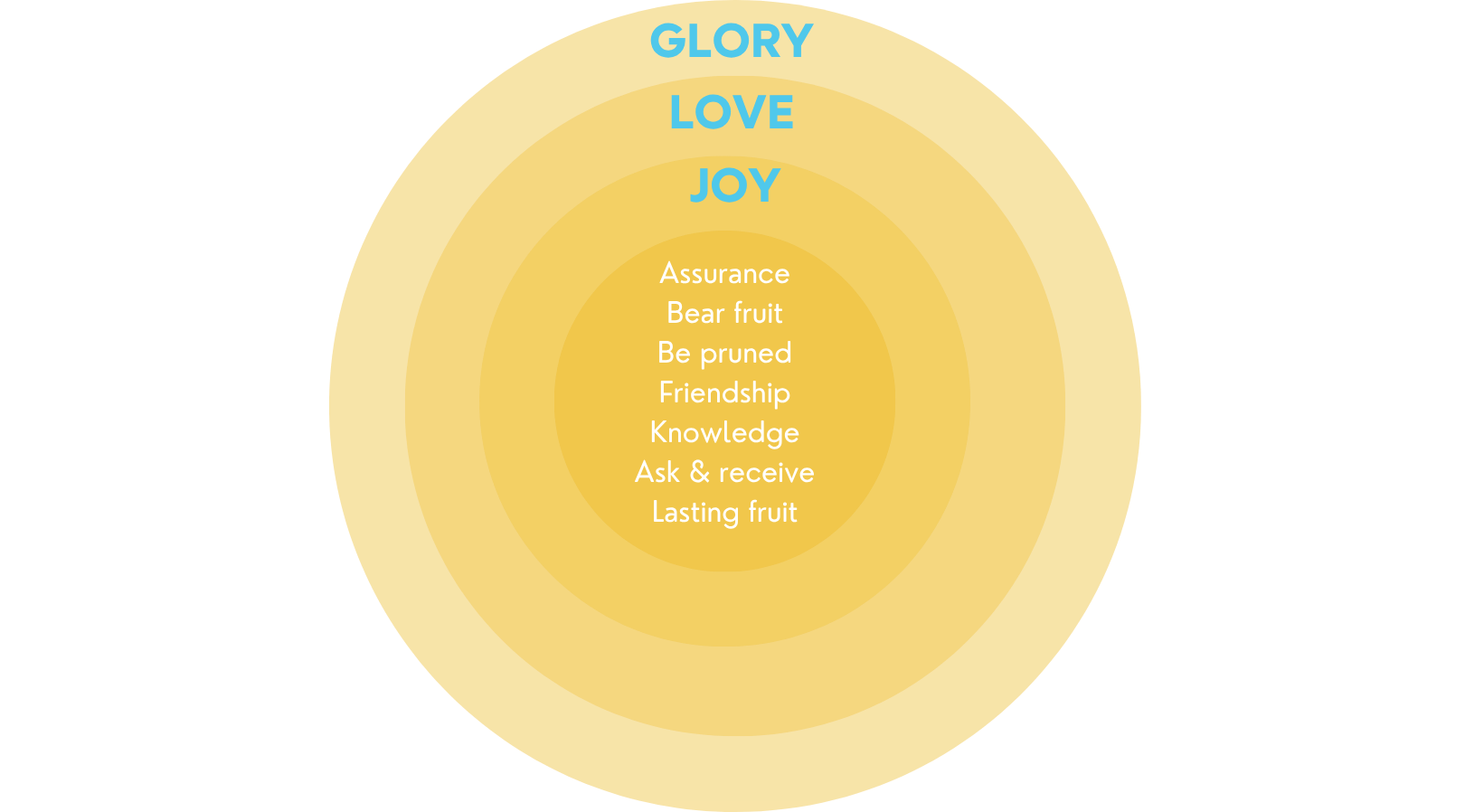
The glory bomb graphic — specific promises in these verses: assurance, fruit, why pruning is a blessing, friendship with Jesus, knowledge of who Jesus is and what the business is, how you ask and receive, and lasting fruit. Know the joy is real.
Abide in Jesus to Do the Work – to Love Like Jesus
Okay, our last point. Abide in Jesus to do the work to love like Jesus. That's what he says to do. Love like him. Jesus wants you to do the work that only you can do by abiding in him. The stuff we can do on our own — not so valuable. The stuff we can do because we can't do it without him — very valuable. It's fruit and it's a joy thing the whole time.
The writer of Hebrews says, "For the joy set before him, Jesus went to the cross despising the shame. He endured it. He's seated at the right hand of the honor of God." He knew he was going to go define love and he was joyful about it. Crucifixion — he was — maybe not the crucifixion itself — but for the task that he had. That's the joy we're called to.
"This is my commandment that you love one another as I have loved you. Greater love has no one than he laid down his life for his friends. You are my friends if you do what I command." That same back and forth a little bit. Keep loving as I've loved you. Now, here's the definition of love. It's laying down your life. It's laying down your life for your friends. It's not saying, "What's in it for me?" It's saying, "What's in it for fruit production? How can this person maybe know Jesus?" Your friends, your family, your workplace — here's what you're supposed to do. This is your greatest commandment. He defined love by dying for us. He was cut off. He was cut off so that we could live. He was one of the branches that was cut off — maybe it was just temporary eternity. And in eternity, I think we'll understand exactly how devastating that was. He sweat blood over it. He was cut off so that we wouldn't be cut off. That's the gospel in a sentence. This is our calling. This is our privilege to love people this way — sacrificially, intentionally. Love defined in this. Bonhoeffer called anything less cheap grace, based on the fact that we're bought with a price. So let's live the same way. We've been paid for. It's done. It's finished. It's over. Now let's go love as we've been loved. And we're friends if we do it.
"No longer do I call you servants, for a servant does not know his master's doing, but I've called you friends. For all that I've heard from my father, I've made known to you." It's not a secret what you need to know. It's clear here in plain language in the Bible, in John's gospel — the whole thing is full of it. I commend it to you. It's the ultimate insider friendship.
Everything else in your life that you're making a decision for — the reason you make the decision is what you serve. And if you make the decision — think about it. Think about the last three or four things that went down wrong. Think about what the object of the service was. It's just true in my life. I can think — 10 are flashing through my eyes. When I chose to serve something else — not so good. When I chose to serve Jesus — fruit. And he calls me friend. He's the only thing you can serve that won't make you a slave. He says he calls you friends. You're inside the business. You're partners. Romans 8:17 says you're heirs. Now suffer with him a little while because everything is going to be yours.
"You did not choose me. Don't think you're earning it. You didn't choose me." When did he choose us? Before the foundation of the world. And he chose you for this reason: that you should go and bear fruit — fruit that should abide. Not only is the fruit in you abiding — maybe you think of the fruits of the spirit: love, joy, peace, patience, kindness, goodness, gentleness, faithfulness, and self-control — but here he's double-clicking on this. Should you go and bear fruit that your fruit should abide? This is people. These are souls that are going to last. God's word, God, his word, and the souls of men are what are going to last. That's what's going to abide forever. It's a soul that abides. It's teaching people about Jesus. There's no greater joy. There's no greater work.
And if you're praying this way — see how is this other promise in the prayers? If you're praying, "Lord, I want to teach somebody about you today. Lord, I'm not sure which person, but make them" — I know one of you had three. You prayed that. Who can I share with today? We had this in Sunday school and he had three of them, didn't you? In that week, he'll do it. If you get so close to him, you pray his will, he'll do it. If you're praying this way in order to do his work, you will start to see things open up. This is how to pray: "Lord Jesus, flow in me and through me so that I will produce fruit that abides — souls of my friends and co-workers that remain forever."
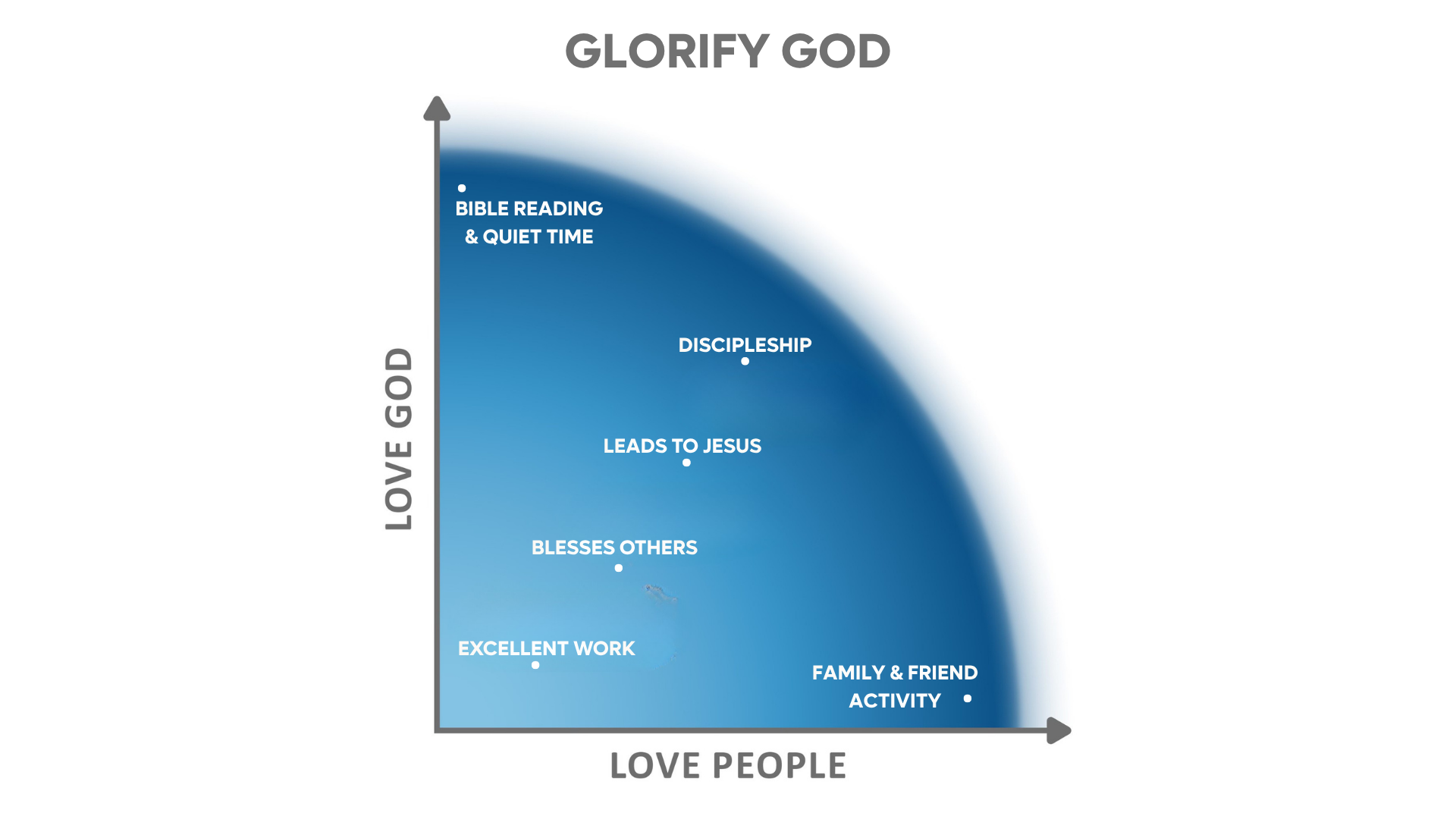
"These things I command you so that you will love one another." What does it mean to love one another? All of life — all of fruit production — can be put between love God and love people. And we do need to read our Bibles and meditate on God's scripture and memorize it even more and more and more. That's at the top of glorifying God and getting to know him.
And somebody asked me — going back to that technology intro — what many of you asked me actually — how early should I have to get up to do my quiet time? Earlier than you need to check anything else. Earlier before the distractions of the world fill in. If you can sleep till 10 and hold back the things of the world for an hour and stay with God, awesome. Do it. But stay with God.
And then this other axis — if you can go to the last slide of the chart — friend activity is really important. We want to love our friends and love our neighbors. But in between there's a growing depth of what it means. I'm going to try to do the same way — to do the work that leads people. Do a good job at your work whatever it is — at home, in your neighborhood, in your workplaces. Make it turn to blessing others. Turn it to leading to Jesus. And then that'll create discipleship. I would argue that the pinnacle of love God — love people — is teaching people about Jesus. And if you pray that, God's going to do it. And if you remain, you'll need to know more stuff. Our friend Sue Campbell says — when somebody says they want you to be their disciple, don't say no. Become the person they want to lead them. All of life is a chance to love God and love people. "These things I command so that you will love one another."
Jesus was cut off so we would abide. He prescribes the best way to remain connected to him is to do the same work he did.
Thank you, Lord, for what you've done for us. We can't begin to describe it. You're working more than we can think or imagine in the background of every moment. There's not a molecule that you're not in control of. There's not a thought that you don't know. There's not where we're headed today that you're not more sure of than we are — or tomorrow or the next day. Help us to trust you. Help us to lean in, want to know you better. Help us to do this very same work you did because you've called us to do it — once we're assured that we're yours — in your name, Jesus. Amen.

Are We Connected?
Who is looking for deeper connection? Who wonders all the benefits that can be had with deeper connections? And those are the things we're going to talk about. But hang on. In my nervousness, I forgot to turn off my alerts on my phone. And Oops. Oh no. I have some alerts. I got four likes on my last post. And somebody said in the comments, "Ah, that's the best." And then there's some World Cup updates. It's pretty cool. And there's a baseball tournament in Hoover. Yeah. Yeah. Uh oh. And rats! Lane Kiffin said more bad stuff about well, you know who. And yikes, a work thing. I think I can wait till after the service or maybe after Sunday. And then one of those cat videos from Aunt Susie. Awesome. I can't wait. (Ha ha)
Friends, is this us? Is this our distraction?
The average American spends 5 hours and 16 minutes a day on their phone. Is this connection? They check their phone 205 times per day. They spend two hours and 20 minutes a day on social media. They check their phone 10 minutes after waking up. Our most frequent connection is wrecking us. And we were made to be connected. Connected deeply.
Here are some of the impacts of that. It's causing mental health deterioration, depression, anxiety, and even suicidal ideation — especially when you add in AI. It's causing sleep destruction and cognitive drain, attention and concentration issues, and relationship erosion. The research doesn't just show that the phones are distracting. It shows they're systematically replacing that which makes human life rich.
You know who said the last thing? That's a quote from Claude. If you don't know Claude, I'll tell you about him later. 71% of Americans admit to spending more time on their phones than with their romantic partners. And it's not much better for Christians. Christians are spending 10 to 20 times more on social media than they are in scripture. Friends, it's not supposed to be that way.
We are made for deep, deep connection. And I'm excited. I'm not worthy, but I'm excited to bring God's word to you today. And these verses — probably no verses have spoken to me more over the last five years. So I'm excited for you to hear the life that is in those.
It’s Always Been About Fruit
The vineyard is a portrait. This is how we're meant to be. The vineyard is a portrait of what you're meant to be. The vineyard is a portrait of what you and your family are meant to be and how you're meant to connect — to bear much fruit. The vineyard is a portrait of Downtown Church and where we want to go — that in God's church, which nothing can stand against across the Bible. Vine, vineyard, fruit, branch, harvest, grapes, wine press — mentioned about a thousand times. The most common of which is fruit. God wants to bear fruit through you.
It all starts in Genesis where abundance is first mentioned. Even before the fall of man, the vine and vineyards are flowing. There's great abundance and fruit. Then the first thing Noah does after the flood is plant a vine. God sees us as his branches. And we were meant to bear fruit. We're meant to be connected to God and fruit-bearing people. And bearing fruit leads to more abiding in God.
But sometimes we don't. And guess what? Israel didn't either. This isn't a New Testament thing. Everything that was meant to be clear is in the Old Testament. But listen, vine references are all over the Psalms and all over the book of Isaiah.
This passage from Isaiah is called a Song of the Vineyard. And you'll be able to see some New Testament in it.
"Let me sing my beloved, my love song concerning his vineyard. My beloved, I have a vineyard on a fertile hill. He dug it. He cleared it of stones and he planted it with choice vines. He built a watchtower in the midst of it and he hewed out a wine vat in it. And he looked for it to yield grapes, but it yielded wild grapes. Oh now, oh inhabitants of Jerusalem, the men of Judah, judge between me and my vineyard. What more was there to do for my vineyard that I have not done for it? When I look for it to yield grapes, why did it yield wild grapes? And now I will tell you what I will do to my vineyard. I will remove the hedge and it shall be devoured. I will break down its wall and it shall be trampled upon. I will make it waste. It shall not be pruned or hoed. And the briars and the thorns shall grow up. I will also command the clouds — no rain upon it. For the vineyard of the Lord of hosts — that is the house of Israel and the men of Judah — are his pleasant planning. And he, God in this case, looked for justice, but behold bloodshed, for righteousness, but behold an outcry." - [.no-reftag]Isaiah 5:1-7[.no-reftag]
And that's just the first seven verses. He goes on from there, the next 10 verses to decry woes. The woes include being too connected to the world and building and connecting farms and connecting houses — and he told you to stay pure and stay on him. And we didn't. Woes regarding being intoxicated, inflamed by strong drink. You know, you'd think of a metaphor about a vine and vineyard would make a little room for drinking wine, but it's saying be very careful with that. And then there are woes — the biggest woe of all — about you deciding what's right about us looking at God's word and saying, "Here's what's right and here's not." He says, "Woe to those who call evil good and good evil, who put darkness for light and light for darkness, who put bitter for sweet and sweet for bitter."
All right, back to our vine.
That's what happens when we're not connected to the vine. God wants to bear fruit. So, do we need a savior? Yes. Are you ready for the good news? So, are you ready for the good news? So, here's our main idea.
Abide. Remain connected to Jesus for assurance and for the joyful, abundant, fruitful life you were made to live.
Note: "Abide" is used 9 times in the ESV in [.no-reftag]John 15:1–11[.no-reftag]; "remain" 10 times. Abide is rich connection, deepness, fellowship with Jesus. Remain means stay connected, stay in Jesus. Don't leave. Some more synonyms if you want them — abide, endure, last, persist, hold on, linger, wait, remain. Do not leave. Stay with him. Abide richly and stay with him. That's the invitation all the time.
This is Personal
Today I know there are those of you who are struggling and need assurance that God is with you. We have people who want to know what life is really about. People that wonder, does a Christian life really matter? We have people not finding joy in Jesus. And I believe this text answers all those things.
So, I invite you right now to take a minute and write down where you're struggling the most just for you. Even if it's an upside opportunity, where has your mind been these last few days? Write it down and see if God's word does not give you an answer today.
So, first we have context. This is the final of the "I Am" statements we've learned. He's the bread of life. I'm the light of the world. I'm the gate. I am the good shepherd. Jesus says, I am the resurrection, the life. I'm the way, the truth, and the life. And that was said in the right now we're in a setting where Jesus is in the upper room talking to his disciples for the last time before he goes out to be arrested, betrayed — arrested, betrayed some more, beaten, scourged, and hung on a cross. So he wants to make sure they get it.
And you'd think "I'm the way, the truth, and life" would be enough, but he wants to tell them one more thing. So he said, "Let's rise and go from here." But first he reminds them everything the father sent him to do he's done. He says let's rise and go. And they make their way from the upper room and they go across most likely the Kidron Valley here and into the Garden of Gethsemane. They would have been really aware that the Passover — so blood would have been flowing down that valley — and he would have been very aware of what his task was in the next few hours. And he's telling them the main thing they need to know when they struggle. Jesus is giving them answers for struggles in all of life.
Okay, so here's our three-point outline. We're supposed to give a three-point outline, right? There's some better preachers in here than me.
Abide in Jesus to Become Like Jesus
First, abide in Jesus to become like Jesus — in the first four verses, what you're meant to be. Then secondly, abide in Jesus to know and have the abundant joy of Jesus — this is what you need to know. And abide in Jesus to do the work to love Jesus — this is what you need to do.
So first, abide in Jesus to become like Jesus. You might say, Howard, that's a little bold — to become like Jesus. Who wants to become like Jesus? Who's sure they're going to be? I want you to be sure. 1 John 3:1–3 gives us a little glimpse. And when we see him, when we behold him, we're going to become like him. And all who have this hope purify themselves because that's what he's offering us. That's what he's offering every one of us.
I remember Michael Davis teaching this at our Way to Work groups at The Center. And he came in — I thought he was teaching on knowing God better. And he immediately started talking about your biggest need. Each of your biggest needs is to become like Jesus. And I was like, "Oh, that's a little too much, Michael." But it's not. It's exactly right. If we know him, we become like him. So that's the goal. So let's break it down into these deep — into these verses — and go a little deeper.
I'm going to read it again because the power is in God's word, not mine. "I am the true vine and my father is the vine dresser. Every branch in me that does not bear fruit, he takes away and every branch that does bear fruit, he prunes that it may bear more fruit." Catch that. That's important. He prunes that it may bear more fruit. "Already you are clean because the word I have spoken to you. Abide in me and I in you. As the branch cannot bear fruit by itself unless it abides in the vine, neither can you unless you abide in me."
All right, notice here Jesus is the true vine. This means Jesus is the source of life. There is no other source of life and he abides in you. He's in you. He's with you. He's for you. Therefore, remain — abide in him. Now the father, the father is the vine dresser. He is the chief gardener. Everything on this planet, everything in this universe is his. And you know what he wants? Maximum fruit production. It's what he wants in your life. Fruit impacting others for fruit.
Presbyterians tend to call this "to glorify God and enjoy him forever." But in doing that — that beautiful statement — it's true. If you've memorized the catechism, it's the first question. But we don't want to miss what it means to glorify God because it's very specific. Glorifying God is maximum fruit production.
The father is cutting away unfruitful branches — that's in verse six. But those that are not God's children, he's cutting away. They will be cut and they'll burn forever. But you — have you been pruned lately? You don't have to raise your hands. This isn't a prune confession. But we've been pruned, haven't we? Some by our own devices, some by — by nothing that we caused at all.
But he says to this: "You that have been pruned, you are clean." These are the same words in the Greek — where Jesus and Peter are kind of wrestling over who's going to wash whose feet. He said, "Already you're clean, Peter, but just — you need your feet to be washed." This is the cleaning. But we need to continue to have our feet washed because we're still sinning and we need to remain. We are clean. We need to abide in him. He is pruning the branches that are his.
This pruning allows the very life source to come. Now, I see a couple of gardeners in here. One I know better than others. But when you prune back a bush, it can look pretty nasty, can't it? Certainly, if I did — actually, I had pruned a few that my wife wasn't very happy about me pruning, but they came back, too. I'm not sure they were pruned well, but they still came back. But the master gardener knows exactly how to prune. And if you see that in a wine valley or another place, you'll see how ugly it looks for a minute. But it comes — and it allows the juice, the very blood of Jesus. It allows it to flow. It allows it to fill up the new growth. It allows you to bear more fruit. This is how a taker becomes a giver. This is how an anxious person becomes free and joyful. Our father disciplines those he loves — through their own actions and through nothing they've done at all. The point is to prepare us to bear more fruit. He wants more fruit out of every single one of us.
Here's the bottom line. Everyone who goes under the knife — yet who believes he's pruned — is cut back and consequences arise. Unexpected things happen. We're cut back. Those who abide are not disconnected and hey don't become bitter and dry away. You'll see life. And you see the some circumstances — when hardship comes, people run and become bitter. Others — when hardship comes — they look for a chance to grow, because they're remaining, or Jesus is just doing that in them — unconsciously, confidently.
So here's the best example lately — many of you have seen this, I've talked about this with many of you — but who's seen some of the Ben Sass interviews? Anybody? I commend them to you. The 60 Minutes — I commend it to you. But he has a podcast — I commend it to you. He was a senator and he was the head of the University of Florida after that. And he just didn't think the Senate was getting things done. And now he's living on borrowed time. But as God would have it, he's a man of strong faith and he got to spend some time with Tim Keller as Tim Keller was dying of pancreatic cancer — the very disease that took Tim Keller from this planet. But he knew — he was sharing with him. Tim had so much hope.
I'll just — I mean I'm not sure — one of the most clarifying moments of my life — as Tim was dying and gave a podcast and said it took until Kathy and I had this cancer that we knew what performance-based Christians we were — until this suffering comes. And he's admitted — I was just on one of my last runs ever — I was just weeping and crying. If that man who's teaching me it's not about performance is saying he has performance too — we're doing some good work here, Lord. Why would you take this back? Well, maybe he's going to teach people to die. And one person he taught to die was Ben Sass.
Ben Sass in these interviews — he's sleeping about 15 hours a day. He's taking trial treatments. And then he's spending time being interviewed all over the country. You can find it. He has more hope and joy and purpose than anyone I've talked to lately. He's clear on things of government. He's clear on things about AI. He's clear on technology. He's clear on what we should be doing. He said, "We're not doing any of what we should be doing. This technology is going to change the world and we need to get ready. We need to stay connected" — is part of what he's saying. And he said — he'd say — if we were connected, we'd be doing different actions in our families and in our businesses and in our government.
Here's what he said. He said it in front of millions and millions of people: "There are no maverick molecules in the universe." Now he's quoting RC Sproul there, but he's saying it there. The guy interviewing him on 60 Minutes appears to not be a believer. And so — "How can you have such hope in the face of death?" And actually, he has more clarity in the face of death than almost anybody I've ever known listening to him. He's able to answer questions like this. He has so much hope. He has so much joy. He doesn't want to die. He's not asking to die. He thinks his girls are in good shape, but he thinks maybe his 14-year-old — you know — he certainly would like to get a few more milestones with him. But he's positive. He's just his own version of saying Romans 8:28. He's positive. God is in control of everything. And therefore, since he's his light and he's connected to him as a vine and he knows he's being pruned, he wants everybody to know about Jesus before he dies. And he gives us some spare advice on government — thank goodness. Praise the Lord. Even our death can bring clarity and joy when we remain in the vine.
Of course, Jesus is saying it even better. God is a great gardener and he's doing everything for maximum fruit production. As a master gardener, Jesus and God are committed to your greatness. That's what they're doing. They want you to be great. They want you to have maximum fruit production. I got that from a Tim Keller sermon — they're committed to your greatness. His mercies are new every morning. He's meeting you in the task. He's meeting you in the challenges. He's meeting you in everything, in the pruning.
And so from here on — we've talked about those in the vine and those not in the vine. The rest of this sermon is meant for you who believe. And yet it's — I hope it's invitational to those who are investigating Jesus at the same time, so that you can know what maximum fruit production is.
All right, here's a graphic and here's a look at what the vine looks like. When I know that the source of my life is Jesus — that I have nothing that's not from him, that I'm not able to do anything that's not through him, and there's no reason to do anything that's not for him — when I know my gifts and my means are lined up, I have peace. When I know — and what we already quoted, 1 John 3 — when I know what I'm — when I get home, I'm going to be with him. That's what life purpose is. Hope is not a strategy. Hope is a person and his name is Jesus.
Abide in Jesus to Know and Have the Abundant Joy of Jesus
Let's move to the second point. Abide in Jesus to have the abundant joy of Jesus. Jesus wants us to know some things about this. Life in him is not all about pruning, but they do require discipline.
Listen to what he says, "I am the vine and you are the branches. Whoever abides in me and I in him, he it is that bears much fruit. For apart from me, you can do nothing. If anyone does not abide in me, he is thrown away like a branch and withers. And the branches are gathered, thrown into the fire, and burned." This is clarity like nowhere else in the world. No one speaks with this authority like Jesus.
No one should be connected to anything deeper than Jesus. He says I am the vine. He says we are the branches. He says without him we can do nothing. With him we can do anything. With him we bear much fruit. But you might be saying, "Wait, I do a lot of stuff. I'm busy all day long." And what’s he saying? Our actions that are not connected to Jesus are worthless. It's not just that he provides the air in our lungs. And I wouldn't even be standing here if he didn't make a way for me to stand here. It's that you're connected to him — that you know and have assurance that what you're doing is right. That's the stuff that's worth doing. That's the work. That is the fruit — when you know you're connected and you know he's filling you.
And I'll say it again — it's the bottom line of this sermon — but I think it's just true that there are many ways to connect and memorizing verses is a very good one, Hillary. And yet maybe as I've prepared for this sermon, what I realize more than anything is when we're doing something there's no way we can do on our own power — that's when we're most connected — when we need him. We need him when we're sick. We pray to him when we're sick and pray for our relatives. We do it. But when we're doing fruit-bearing work we can't do without him in any way — so we need to stay connected. Some of you can do this unconsciously, by the way. You can be so connected and pray without ceasing. But a lot of times it takes conscious connection. He abides in us.
"If you abide in me and my words abide in you, ask whatever you wish and it will be done for you. By this my father is glorified that you bear much fruit and prove to be my disciples." Now who's praying for some stuff that hasn't happened? It happens to him, too. What's he saying here? Abide in me. Ask whatever you wish and it will be done for you. He's saying there's a deep connection.
Who's prayed something so deep and so meaningful when you know you've been connected to Jesus and you know it's from him and you know he's listened to you and you know it's going to happen — and you can praise him for it even before it happens? That's what he wants for you. It's what he's saying here. He's defining what it means to abide so tightly that when you pray, you pray the will of God in your prayers because you're so connected to him. Yes, it takes a lot of God's word to do that. But so much of our prayer is seeking mechanical correction — can I get this right? Can I fix that? Can we get this plugged in? Can this stop? All these things that we pray for. But he's saying — Tim Keller is saying — quit seeking mechanical correction. Quit seeking to do things right. God is offering organic internal transformation. He's offering us complete transformation. That's how you bear more fruit. So when you pray "his kingdom come, his will be done," you also ask Jesus what's maximum fruit production today — because that's his kingdom coming. His will be done now on earth as it is in heaven.
"As the father loved me, so I have loved you. Abide in my love. If you keep my commandments, you'll abide in my love, just as I have kept my father's commandments and abide in his love." Friends, hear this. You are loved exactly as the father loves the son. That's how well loved you are. None of us have the capacity for that for each other. But Jesus loves you exactly the way the father loves him.
And he's saying this is all really connected, by the way, because Jesus has said all along — all throughout this Gospel of John — "I can do nothing without the father." That's what not sinning is. We stay so focused on the stuff we don't want to sin — we've missed the mission. Jesus is saying, "I did nothing that wasn't the will of the father. I can't do anything without him." And he's telling us we can't do anything without him. And yet he's providing it. It's an invitation. He's saying, "Come on and do this." You're loved the way the father loves Jesus. This is the way. Is this encouraging? You're loved that way. Can you believe it? You're loved perfectly. Not everybody in your life is treating you perfectly, but you are loved perfectly. That's the promise. That's what your savior is saying.
If the love of Christ is flowing through you — healing you and preparing you. He's saying, "Now abide." If you keep his commandments — wait a minute, now we're going backwards. I thought he just loved me perfectly. I thought — this I'm telling you, John's gospel is sort of like the book of Ephesians. Each verse sort of answers the next verse. So, wait a minute. I'm loved more than I can think or imagine, but if I keep his commandments — but I know this whole deal is not performance because he did it all. He accomplished it. It's done. It's finished. He's paid for every sin. What is it that I must do? And this is what he's saying: when you follow his commands, you know you're loved. When you walk with him, when you know you're with him, when you're getting up and in his word — you get reassured that you're loved. And when you're doing what he says do, you know you're loved. It's reinforcing all the time. That's what life in the vine is — reinforcement, constantly flowing and building more and more fruit off of you when you follow his commands.
"These things I've spoken to you that my joy may be in you and that your joy may be full." That's what he wants for you. Complete and full and abundant joy — by knowing you're loved, by staying in his commands. More joy, more love all the time. This is God's purpose for your life.
The glory bomb graphic — specific promises in these verses: assurance, fruit, why pruning is a blessing, friendship with Jesus, knowledge of who Jesus is and what the business is, how you ask and receive, and lasting fruit. Know the joy is real.
Abide in Jesus to Do the Work – to Love Like Jesus
Okay, our last point. Abide in Jesus to do the work to love like Jesus. That's what he says to do. Love like him. Jesus wants you to do the work that only you can do by abiding in him. The stuff we can do on our own — not so valuable. The stuff we can do because we can't do it without him — very valuable. It's fruit and it's a joy thing the whole time.
The writer of Hebrews says, "For the joy set before him, Jesus went to the cross despising the shame. He endured it. He's seated at the right hand of the honor of God." He knew he was going to go define love and he was joyful about it. Crucifixion — he was — maybe not the crucifixion itself — but for the task that he had. That's the joy we're called to.
"This is my commandment that you love one another as I have loved you. Greater love has no one than he laid down his life for his friends. You are my friends if you do what I command." That same back and forth a little bit. Keep loving as I've loved you. Now, here's the definition of love. It's laying down your life. It's laying down your life for your friends. It's not saying, "What's in it for me?" It's saying, "What's in it for fruit production? How can this person maybe know Jesus?" Your friends, your family, your workplace — here's what you're supposed to do. This is your greatest commandment. He defined love by dying for us. He was cut off. He was cut off so that we could live. He was one of the branches that was cut off — maybe it was just temporary eternity. And in eternity, I think we'll understand exactly how devastating that was. He sweat blood over it. He was cut off so that we wouldn't be cut off. That's the gospel in a sentence. This is our calling. This is our privilege to love people this way — sacrificially, intentionally. Love defined in this. Bonhoeffer called anything less cheap grace, based on the fact that we're bought with a price. So let's live the same way. We've been paid for. It's done. It's finished. It's over. Now let's go love as we've been loved. And we're friends if we do it.
"No longer do I call you servants, for a servant does not know his master's doing, but I've called you friends. For all that I've heard from my father, I've made known to you." It's not a secret what you need to know. It's clear here in plain language in the Bible, in John's gospel — the whole thing is full of it. I commend it to you. It's the ultimate insider friendship.
Everything else in your life that you're making a decision for — the reason you make the decision is what you serve. And if you make the decision — think about it. Think about the last three or four things that went down wrong. Think about what the object of the service was. It's just true in my life. I can think — 10 are flashing through my eyes. When I chose to serve something else — not so good. When I chose to serve Jesus — fruit. And he calls me friend. He's the only thing you can serve that won't make you a slave. He says he calls you friends. You're inside the business. You're partners. Romans 8:17 says you're heirs. Now suffer with him a little while because everything is going to be yours.
"You did not choose me. Don't think you're earning it. You didn't choose me." When did he choose us? Before the foundation of the world. And he chose you for this reason: that you should go and bear fruit — fruit that should abide. Not only is the fruit in you abiding — maybe you think of the fruits of the spirit: love, joy, peace, patience, kindness, goodness, gentleness, faithfulness, and self-control — but here he's double-clicking on this. Should you go and bear fruit that your fruit should abide? This is people. These are souls that are going to last. God's word, God, his word, and the souls of men are what are going to last. That's what's going to abide forever. It's a soul that abides. It's teaching people about Jesus. There's no greater joy. There's no greater work.
And if you're praying this way — see how is this other promise in the prayers? If you're praying, "Lord, I want to teach somebody about you today. Lord, I'm not sure which person, but make them" — I know one of you had three. You prayed that. Who can I share with today? We had this in Sunday school and he had three of them, didn't you? In that week, he'll do it. If you get so close to him, you pray his will, he'll do it. If you're praying this way in order to do his work, you will start to see things open up. This is how to pray: "Lord Jesus, flow in me and through me so that I will produce fruit that abides — souls of my friends and co-workers that remain forever."
"These things I command you so that you will love one another." What does it mean to love one another? All of life — all of fruit production — can be put between love God and love people. And we do need to read our Bibles and meditate on God's scripture and memorize it even more and more and more. That's at the top of glorifying God and getting to know him.
And somebody asked me — going back to that technology intro — what many of you asked me actually — how early should I have to get up to do my quiet time? Earlier than you need to check anything else. Earlier before the distractions of the world fill in. If you can sleep till 10 and hold back the things of the world for an hour and stay with God, awesome. Do it. But stay with God.
And then this other axis — if you can go to the last slide of the chart — friend activity is really important. We want to love our friends and love our neighbors. But in between there's a growing depth of what it means. I'm going to try to do the same way — to do the work that leads people. Do a good job at your work whatever it is — at home, in your neighborhood, in your workplaces. Make it turn to blessing others. Turn it to leading to Jesus. And then that'll create discipleship. I would argue that the pinnacle of love God — love people — is teaching people about Jesus. And if you pray that, God's going to do it. And if you remain, you'll need to know more stuff. Our friend Sue Campbell says — when somebody says they want you to be their disciple, don't say no. Become the person they want to lead them. All of life is a chance to love God and love people. "These things I command so that you will love one another."
Jesus was cut off so we would abide. He prescribes the best way to remain connected to him is to do the same work he did.
Thank you, Lord, for what you've done for us. We can't begin to describe it. You're working more than we can think or imagine in the background of every moment. There's not a molecule that you're not in control of. There's not a thought that you don't know. There's not where we're headed today that you're not more sure of than we are — or tomorrow or the next day. Help us to trust you. Help us to lean in, want to know you better. Help us to do this very same work you did because you've called us to do it — once we're assured that we're yours — in your name, Jesus. Amen.