
Drop The I
%20copy.png)
Drop The I
Drop The I
Drop The I
Everyone is on a road. Your faith commitments — whatever they are — are taking you somewhere. Most roads are wide. Wide makes room for the I, the performance, the divided heart. On the narrow road, the person can pass through, the I cannot. This is the invitation.
[.text-color-blue]The Hardest Pronoun to Surrender[.text-color-blue]
There is one thing that is the most difficult to surrender. It’s not comfort, pleasure, or security. It’s the need to be self-directed and to trust in our own efforts to take us where we need to go.
“I do to get ____.” The I, me, or even the we is too often the hidden engine behind almost everything we do.
The world formed us this way before we were old enough to choose otherwise. Grades. Trophies. Performance reviews. The resume. Our work can reinforce the performance based lie of “If it’s to be, it’s up to me.”
By adulthood, performance isn’t just a habit. It’s an identity.
The logic underneath is transactional. I do to get. I attend, so God protects my family. I give, so God blesses my finances. I serve, so God gives me a life that works. The verbs vary; the hidden bargain is always the same. And the problem with the I do to get life isn’t merely that it’s selfish — it’s that it is structurally broken. You cannot out-perform a God who has already given you everything.
This is not surrender. It is performance with me at the center. And it is the greatest impediment to the fruitful life Jesus actually came to offer — not just in the next life, but in this one.
“How close to spirituality one may come, while knowing nothing of its fundamental character.” - Tim Keller
The Invitation of The Gospel
If there is a single place in Scripture that addresses the performance trap at its root, it is the Sermon on the Mount. The single mistake that most distorts how we read it is this: we come to it as a checklist.
The Gospel is an invitation, not an instruction manual.
The first words of the greatest sermon ever preached are not commands.
Jesus is teaching about the postures and positions of people who have accepted the Good News. Jesus is not describing a new ethic to keep. He is describing what it looks like to live successfully in the kingdom of God now.
“Blessed are the poor in spirit” — those who bring nothing, claim nothing, perform nothing. They stand before God with empty hands, and Jesus says they already possess the kingdom.
“Blessed are those who mourn” — not sorrow as a technique, but the grief that arrives when a person finally sees clearly what their self-sufficiency has cost.
“Blessed are the meek” — those who have stopped fighting for their own position, stopped demanding a particular outcome. The meek person has released the result.
These three portraits describe a single person: someone who has come to the end of themselves. This is not a program to complete. It is a picture of full surrender — and Jesus pronounces it blessed.
The tragedy is that we read even this as a checklist. You cannot perform your way into poverty of spirit. It only arrives when you have stopped.
The Object of Surrender
Jesus teaches His disciples to pray — and the first words tell us everything:
“Our Father in heaven, hallowed be your name, your kingdom come, your will be done.” - [.no-reftag]Matthew 6:9-10[.no-reftag]
Three phrases. Three surrenders. Your name. Your kingdom. Your will. Notice what is entirely absent: no résumé, no accounting of accomplishments. The person who prays this way has already dropped the I before reaching the second sentence.
The hallowed-name life is organized around who God is, not what I want from God. The person who has spent a lifetime hallowing His name will not need to say a word when they meet Jesus. The Apostle John fell at His feet as though dead. No one who has surrendered their life to Jesus will be reaching for a résumé when they meet Him face to face.
One Aim. One Allegiance. One Life.
“No one can serve two masters.” (Matthew 6:24) Not should not — cannot. The divided heart is not just spiritually unwise. It is structurally impossible.
Anxiety is the fruit of a divided heart — what happens when you are trying to manage outcomes you have not surrendered. The person who has released the future can look at the birds of the air and find, in them, an argument for peace.
And then the hinge of the entire sermon:
“Seek first his kingdom and his righteousness, and all these things will be given to you as well.” - [.no-reftag]Matthew 6:33[.no-reftag]
This is the difference between working for Jesus and working with Him. Working for Jesus keeps you performing — measuring output, anxious about results, fundamentally in charge. Working with Jesus means surrendering the outcome. The relationship is the point. The fruit flows from the relationship.
The Road and the Gate
Everyone is on a road. Your faith commitments — whatever they are — are taking you somewhere. There is no standing still.
Most roads are wide. Wide makes room for the I, the performance, the divided heart. Wide never requires you to set anything down.
“Small is the gate and narrow the road that leads to life, and only a few find it.” - [.no-reftag]Matthew 7:14[.no-reftag]
The narrow road narrows as you walk it. The gate at the end is narrow enough that you cannot carry the I through it — not because God refuses you, but because the gate was built to press it off you. The person can pass through. The I cannot.
“Unless a kernel of wheat falls to the ground and dies, it remains only a single seed. But if it dies, it produces many seeds.” - [.no-reftag]John 12:24[.no-reftag]
This is not a threat. This is the invitation.
The Terrifying Résumé
Near the end of the sermon Jesus speaks some of the most alarming words in Scripture:
“Not everyone who says to me, ‘Lord, Lord,’ will enter the kingdom of heaven, but only the one who does the will of my Father who is in heaven. Many will say to me on that day, ‘Lord, Lord, did we not prophesy in your name and in your name drive out demons and in your name perform many miracles?’ Then I will tell them plainly, ‘I never knew you. Away from me, you evildoers!’” - [.no-reftag]Matthew 7:21-23[.no-reftag]
These are not casual churchgoers. These are people with genuine spiritual accomplishments. And they are standing in the presence of God, presenting their credentials.
“Did we not… did we not… did we not?”
Every verb has the same subject. The performance instinct followed them into eternity. They arrived at the throne with a résumé.
The we, we, we reveals something more alarming than pride — it reveals the relationship was never real. Because you cannot genuinely know this God and stand before Him leading with your accomplishments. The person who truly knows God will not be able to contain themselves in His presence. You will have no desire to explain yourself.
- "You are my portion." (Psalm 16:5)
- “I lack nothing.” (Psalm 23:1)
- “My cup overflows.” (Psalm 23:5)
- “Your mercies are new every morning.” (Lamentations 3:22-23)
These are the responses of a heart who has met with God.
The person who truly surrenders to Jesus arrives the way the prodigal son arrived home — with nothing to offer, trying to apologize deeply. Yet, finding our Father running toward us, forgiving us, restoring us, offering us new mercy, and celebrating that we were once lost and are now found!
The Invitation
The Sermon on the Mount begins with those who have nothing to offer — and Jesus pronounces them blessed.
It ends with a warning about those who had everything to offer — and were never known. Jesus also gives a parable about two men, and the two houses that they built.
The invitation is to surrender to a Person — His Way, His Truth, His Life — Jesus has never once failed those who trust Him. Jesus meets the empty-handed not with disappointment, but with the kingdom of God.
The gate is narrow enough. You are not too much. Your I is.
Surrender what you cannot keep. Receive what you could never earn. And build — together with Him — the kingdom on earth, as it will one day fully be in heaven.
Where Is Your Heart Right Now?
This is not a checklist. It is a window — to reveal where you already are, so you can bring that honestly to the One who invites you.
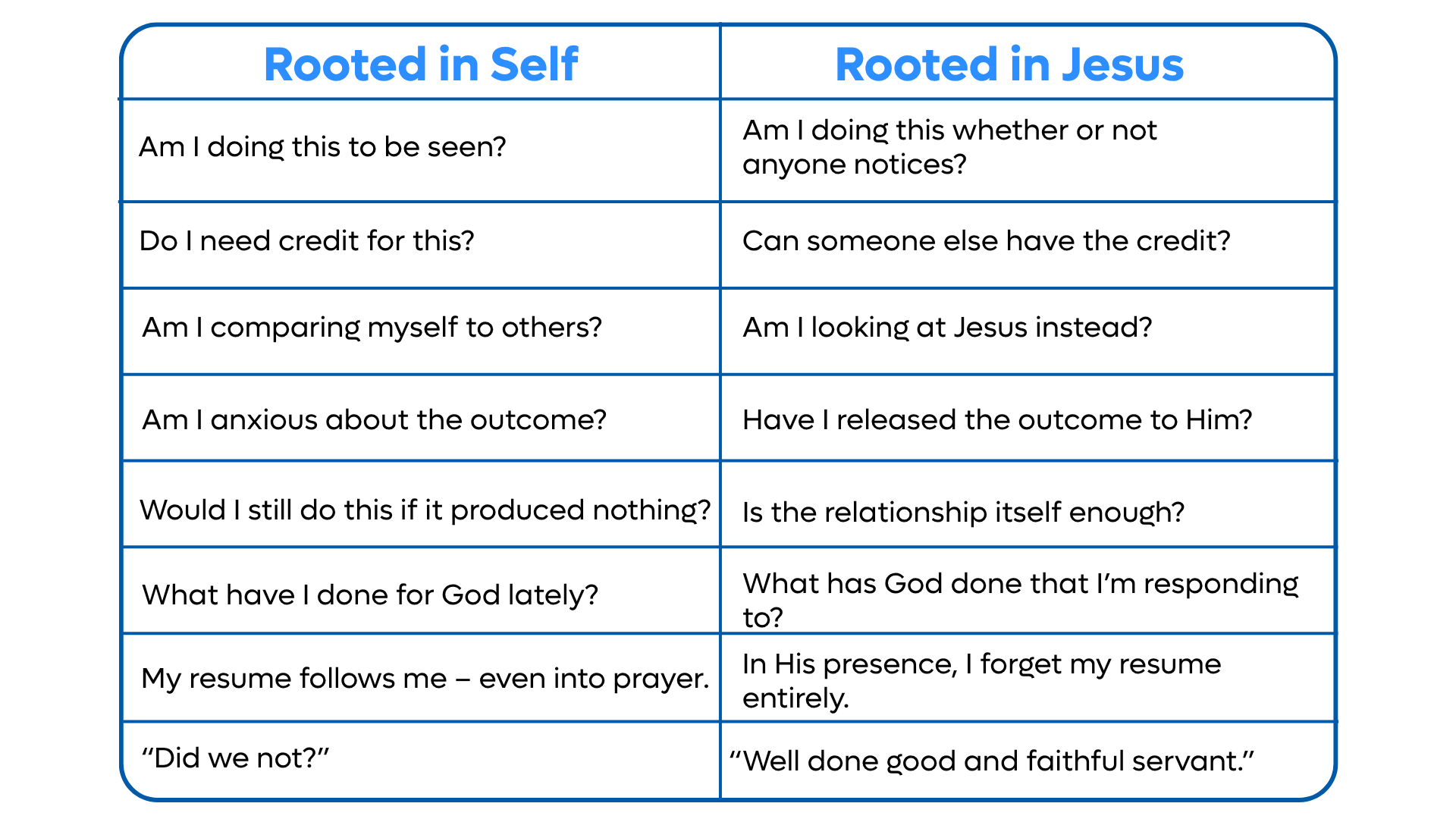
The left column is the human condition — the road we all start on. The right is what grows in a life surrendered to Jesus.
The Fruit Reveals the Root
“By their fruit you will recognize them. Do people pick grapes from thornbushes, or figs from thistles? Likewise, every good tree bears good fruit, but a bad tree bears bad fruit. A good tree cannot bear bad fruit, and a bad tree cannot bear good fruit. Every tree that does not bear good fruit is cut down and thrown into the fire. Thus, by their fruit you will recognize them.” - [.no-reftag]Matthew 7:16-20[.no-reftag]
Jesus is offering an unimaginable fruit-filled life — full of abundance of glory, light, grace, and love. Trust Him.
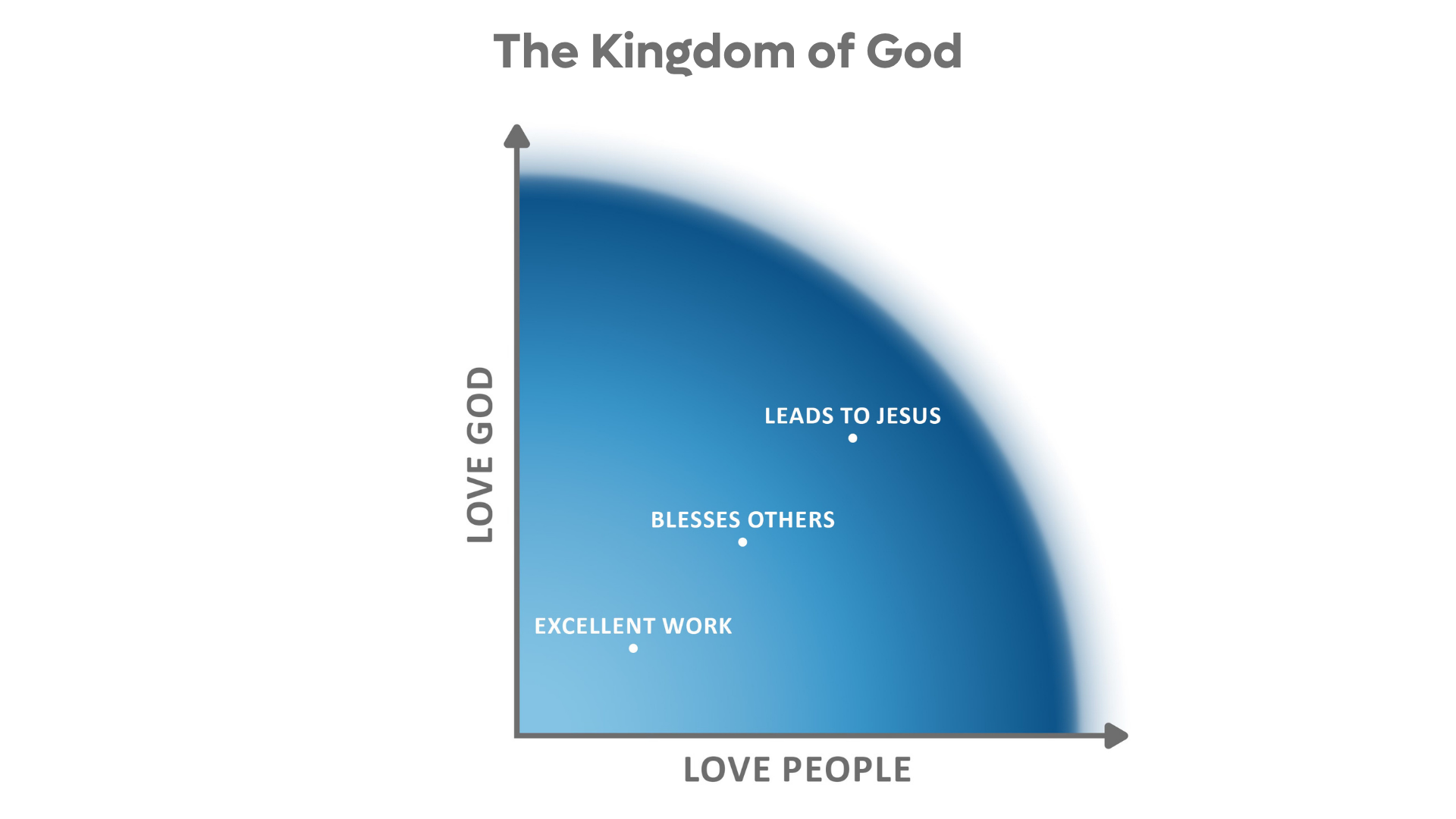
Answer the call to work with Jesus to produce lasting fruit — building the kingdom of God on earth as it is in heaven.
Drop the I. Enter through the gate. On the other side, you will find Jesus.
Resources:
Sermon: The Rich Young Ruler | Elliot Cherry
Article: Receive Your Blessing, Accept Your Call | Howard Graham
Article: Built on Bedrock | Howard Graham
Sermon: Three Ways to Live | Tim Keller
Article: Making the Most Powerful Connection Possible | Howard Graham

[.text-color-blue]The Hardest Pronoun to Surrender[.text-color-blue]
There is one thing that is the most difficult to surrender. It’s not comfort, pleasure, or security. It’s the need to be self-directed and to trust in our own efforts to take us where we need to go.
“I do to get ____.” The I, me, or even the we is too often the hidden engine behind almost everything we do.
The world formed us this way before we were old enough to choose otherwise. Grades. Trophies. Performance reviews. The resume. Our work can reinforce the performance based lie of “If it’s to be, it’s up to me.”
By adulthood, performance isn’t just a habit. It’s an identity.
The logic underneath is transactional. I do to get. I attend, so God protects my family. I give, so God blesses my finances. I serve, so God gives me a life that works. The verbs vary; the hidden bargain is always the same. And the problem with the I do to get life isn’t merely that it’s selfish — it’s that it is structurally broken. You cannot out-perform a God who has already given you everything.
This is not surrender. It is performance with me at the center. And it is the greatest impediment to the fruitful life Jesus actually came to offer — not just in the next life, but in this one.
“How close to spirituality one may come, while knowing nothing of its fundamental character.” - Tim Keller
The Invitation of The Gospel
If there is a single place in Scripture that addresses the performance trap at its root, it is the Sermon on the Mount. The single mistake that most distorts how we read it is this: we come to it as a checklist.
The Gospel is an invitation, not an instruction manual.
The first words of the greatest sermon ever preached are not commands.
Jesus is teaching about the postures and positions of people who have accepted the Good News. Jesus is not describing a new ethic to keep. He is describing what it looks like to live successfully in the kingdom of God now.
“Blessed are the poor in spirit” — those who bring nothing, claim nothing, perform nothing. They stand before God with empty hands, and Jesus says they already possess the kingdom.
“Blessed are those who mourn” — not sorrow as a technique, but the grief that arrives when a person finally sees clearly what their self-sufficiency has cost.
“Blessed are the meek” — those who have stopped fighting for their own position, stopped demanding a particular outcome. The meek person has released the result.
These three portraits describe a single person: someone who has come to the end of themselves. This is not a program to complete. It is a picture of full surrender — and Jesus pronounces it blessed.
The tragedy is that we read even this as a checklist. You cannot perform your way into poverty of spirit. It only arrives when you have stopped.
The Object of Surrender
Jesus teaches His disciples to pray — and the first words tell us everything:
“Our Father in heaven, hallowed be your name, your kingdom come, your will be done.” - [.no-reftag]Matthew 6:9-10[.no-reftag]
Three phrases. Three surrenders. Your name. Your kingdom. Your will. Notice what is entirely absent: no résumé, no accounting of accomplishments. The person who prays this way has already dropped the I before reaching the second sentence.
The hallowed-name life is organized around who God is, not what I want from God. The person who has spent a lifetime hallowing His name will not need to say a word when they meet Jesus. The Apostle John fell at His feet as though dead. No one who has surrendered their life to Jesus will be reaching for a résumé when they meet Him face to face.
One Aim. One Allegiance. One Life.
“No one can serve two masters.” (Matthew 6:24) Not should not — cannot. The divided heart is not just spiritually unwise. It is structurally impossible.
Anxiety is the fruit of a divided heart — what happens when you are trying to manage outcomes you have not surrendered. The person who has released the future can look at the birds of the air and find, in them, an argument for peace.
And then the hinge of the entire sermon:
“Seek first his kingdom and his righteousness, and all these things will be given to you as well.” - [.no-reftag]Matthew 6:33[.no-reftag]
This is the difference between working for Jesus and working with Him. Working for Jesus keeps you performing — measuring output, anxious about results, fundamentally in charge. Working with Jesus means surrendering the outcome. The relationship is the point. The fruit flows from the relationship.
The Road and the Gate
Everyone is on a road. Your faith commitments — whatever they are — are taking you somewhere. There is no standing still.
Most roads are wide. Wide makes room for the I, the performance, the divided heart. Wide never requires you to set anything down.
“Small is the gate and narrow the road that leads to life, and only a few find it.” - [.no-reftag]Matthew 7:14[.no-reftag]
The narrow road narrows as you walk it. The gate at the end is narrow enough that you cannot carry the I through it — not because God refuses you, but because the gate was built to press it off you. The person can pass through. The I cannot.
“Unless a kernel of wheat falls to the ground and dies, it remains only a single seed. But if it dies, it produces many seeds.” - [.no-reftag]John 12:24[.no-reftag]
This is not a threat. This is the invitation.
The Terrifying Résumé
Near the end of the sermon Jesus speaks some of the most alarming words in Scripture:
“Not everyone who says to me, ‘Lord, Lord,’ will enter the kingdom of heaven, but only the one who does the will of my Father who is in heaven. Many will say to me on that day, ‘Lord, Lord, did we not prophesy in your name and in your name drive out demons and in your name perform many miracles?’ Then I will tell them plainly, ‘I never knew you. Away from me, you evildoers!’” - [.no-reftag]Matthew 7:21-23[.no-reftag]
These are not casual churchgoers. These are people with genuine spiritual accomplishments. And they are standing in the presence of God, presenting their credentials.
“Did we not… did we not… did we not?”
Every verb has the same subject. The performance instinct followed them into eternity. They arrived at the throne with a résumé.
The we, we, we reveals something more alarming than pride — it reveals the relationship was never real. Because you cannot genuinely know this God and stand before Him leading with your accomplishments. The person who truly knows God will not be able to contain themselves in His presence. You will have no desire to explain yourself.
- "You are my portion." (Psalm 16:5)
- “I lack nothing.” (Psalm 23:1)
- “My cup overflows.” (Psalm 23:5)
- “Your mercies are new every morning.” (Lamentations 3:22-23)
These are the responses of a heart who has met with God.
The person who truly surrenders to Jesus arrives the way the prodigal son arrived home — with nothing to offer, trying to apologize deeply. Yet, finding our Father running toward us, forgiving us, restoring us, offering us new mercy, and celebrating that we were once lost and are now found!
The Invitation
The Sermon on the Mount begins with those who have nothing to offer — and Jesus pronounces them blessed.
It ends with a warning about those who had everything to offer — and were never known. Jesus also gives a parable about two men, and the two houses that they built.
The invitation is to surrender to a Person — His Way, His Truth, His Life — Jesus has never once failed those who trust Him. Jesus meets the empty-handed not with disappointment, but with the kingdom of God.
The gate is narrow enough. You are not too much. Your I is.
Surrender what you cannot keep. Receive what you could never earn. And build — together with Him — the kingdom on earth, as it will one day fully be in heaven.
Where Is Your Heart Right Now?
This is not a checklist. It is a window — to reveal where you already are, so you can bring that honestly to the One who invites you.
The left column is the human condition — the road we all start on. The right is what grows in a life surrendered to Jesus.
The Fruit Reveals the Root
“By their fruit you will recognize them. Do people pick grapes from thornbushes, or figs from thistles? Likewise, every good tree bears good fruit, but a bad tree bears bad fruit. A good tree cannot bear bad fruit, and a bad tree cannot bear good fruit. Every tree that does not bear good fruit is cut down and thrown into the fire. Thus, by their fruit you will recognize them.” - [.no-reftag]Matthew 7:16-20[.no-reftag]
Jesus is offering an unimaginable fruit-filled life — full of abundance of glory, light, grace, and love. Trust Him.
Answer the call to work with Jesus to produce lasting fruit — building the kingdom of God on earth as it is in heaven.
Drop the I. Enter through the gate. On the other side, you will find Jesus.
Resources:
Sermon: The Rich Young Ruler | Elliot Cherry
Article: Receive Your Blessing, Accept Your Call | Howard Graham
Article: Built on Bedrock | Howard Graham
Sermon: Three Ways to Live | Tim Keller
Article: Making the Most Powerful Connection Possible | Howard Graham